0

Join our list and get 5 free video / tab downloads!

The Synchronicity Seminar is here!

Trapped Motion

By

In a trapped picking motion, upstrokes and downstrokes remain below the plane of the strings.

A trapped pickstroke begins in the trapped zone on one side of the string you want to play, pushes across the string to play the note, and finishes in the trapped zone on the other side of the string:

Since the pickstroke starts and ends in the trapped zone, this means that the point of the pick never rises above the plane of the strings. So if you continue a trapped pickstroke far enough past the string you’re playing, you’ll eventually come into contact with one of the surrounding strings. Here’s nylon-string maestro Jorge Strunz doing exactly that:

Jorge's Trapped Motion

Video access level: Masters in Mechanics

Of all the great players we’ve interviewed, Jorge is the only one who uses a trapped motion as his primary picking motion. As you can see in this slow motion example, Jorge actually rest strokes on upstrokes and downstrokes, hitting the strings on either side of the one he’s playing. This makes it very clear that his motion really is trapped in both directions.

With seemingly no way out, this type of trapped picking motion should create a problem during string changes. And yet, Jorge is famous for his long scalar sequences that float effortlessly across the strings:

Elbow And Wrist

Video access level: Masters in Mechanics

And this is pretty strange. How is Jorge getting across the strings without hitting anything?

Swiping

It turns out, he isn’t. Using a trapped motion while picking across the strings means that you’ll hit one of the surrounding unplayed strings, since the pick isn’t trying to get over them. We call this type of string contact swiping, and it’s a thing that great players like Jorge actually do. Instead of lifting the pick over the strings that are in the way, Jorge simply swipes, or plays right through them:

Tens Eights Sixes Circular Closeup

Video access level: Masters in Mechanics

In this example, at every string change, you’ll see the pick hit two strings in rapid succession. The first one is the string Jorge just finished picking, except it’s muted so it doesn’t make any sound. That’s the swipe. Right after that, the pick keeps going in the same direction and plays the new string. That’s the pitch we actually hear. And again, the reason Jorge does this is that he needs to be on the other side of the current string to reach the new one with alternate picking, but he has no way of getting over it. So he just pushes through it.

To make this work, Jorge uses a high degree of edge picking to help the pick slide over the swipe string, and fretting-hand muting to deaden the pitch that would occur from playing it. If you listen closely, you can still hear some muted noise in Jorge’s lines, along with the occasional un-muted open string. But considering that he’s swiping almost every string change, Jorge’s use of the technique is almost magically quiet at times.

Systematic vs Accidental Swiping

Jorge is unique among players we’ve filmed in that he has made trapped motion and swiping a core part of his technique in both directions, by allowing the pick to move straight through a string that’s in the way.

In slow motion, we can see that he isn’t making a motion to get over the string. Instead, what we see are trapped pickstrokes which look the same during string changes as they do while playing notes on a single string. So Jorge’s use of swiping is systematic swiping because he’s actually relying on it to make the string changes work.

By contrast, everyone hits some unintended strings once in a while. After all, they are pretty close together. When it’s a great player that does it, the line usually still sounds fine, and the motions usually still look correct when you film them.

For example, here’s picking pioneer Steve Morse applying his famous double escape motion to a tricky scale fingering that mixes three and two notes per string:

Scale Fourth Finger Downstroke

Video access level: Masters in Mechanics

Dropping into slow motion, we can see some swiping on the descending side around the G and D strings:

Scale Fourth Finger Downstroke

Video access level: Masters in Mechanics

But the pickstrokes at that moment are actually still double escape pickstrokes, and they still clear the strings in both directions. This is not systematic swiping because these are genuine escape strokes, just a little off-center, causing untintentional contact. That’s what makes this accidental swiping.

Not all mistakes are created equal. A player who is still learning escape motion and slams head-first into a string with a trapped pickstroke is likely to make an audible noise, especially if they hit an open string that’s not muted. An experienced player with fully learned technique who misplaces an escape stroke by a small amount might only glance the string. That kind of mistake would probably be inaudible most of the time, and almost certainly invisible without a camera.

Sweeping

If moving to a new string always forces you to hit a string that’s in the way, why not just play that string? Like swiping, it turns out that this is also something that great players do pretty often. Probably the most famous example of a trapped pickstroke in lead playing is the sweep, where a single trapped pickstroke plays two or more strings. Here’s sweep master Frank Gambale playing all six strings with one of his signature add2 shapes:

Fourths Trill Bass

Video access level: Masters in Mechanics

In this example, Frank plays an upstroke sweep — a trapped upstroke which flows across all six strings, sounding a single note on each of them. As you can see in slow motion, the pick simply flops over the top of each string as it moves past:

Fourths Trill Bass

Video access level: Masters in Mechanics

Technically speaking, there is a brief instant while the pick is playing each string when it is actually escaped. And of course this is the same thing that happens any time you pluck a string with a pick — the pick always flops over the top, a topic we cover in detail in the pick design and function section of the Primer. But this is really just the string pushing the pick out of the way, or vice versa. Frank isn’t actually making a motion that escapes, so we still think of a sweep as a trapped pickstroke as far as the playing technique itself is concerned.

You can sweep on upstrokes and downstrokes, across a few strings or many:

Four-String Circular 11ths

Video access level: Masters in Mechanics

When you connect downstroke sweeps with upstroke sweeps as Frank is doing here, you are essentially making a really big alternate picking motion that encompasses multiple strings at a time. Because Frank is lifting his fretting fingers as he does this, we hear the phrase as individual notes rather than a chord whose notes run together.

Frank uses a combination of wrist and finger motion, but like many of the techniques we’ve examined, sweeping can be accomplished with a variety of different physical motions. Shred pioneer Michael Angelo Batio generates his famously smooth arpeggio sweeps using a combination of shoulder and elbow joint action to track the entire arm across the strings:

Arpeggio Sweep Hi Gain

Video access level: Masters in Mechanics

DBX Motion

By

In a double escape or DBX motion, upstrokes and downstrokes are both escape strokes, allowing string changes after any pickstroke.

Unlike USX and DSX single-escape motions, double escape motion doesn’t trace a diagonal path but actually a semicircular one, where each end of the motion moves above the strings, into the escape zone:

When you play multi-string phrases with double escape motion, it doesn’t matter which pickstroke is the final note on the string because every pickstroke can be a string change pickstroke if you want it to be. The curved nature of the picking motion causes both upstrokes and downstrokes to escape:

Picking pioneer Steve Morse makes dramatic use of double escape motion in his many arpeggiated signature phrases. His ability to tackle these kinds of lines with speed and smoothness has long been referenced by rock players as a benchmark of alternate picking ability, with his song “Tumeni Notes” in particular often cited as a prime example of his superpowers:

Tumeni Intro Clean Tone

Video access level: Masters in Mechanics

It’s a rare treat to see one of the great techniques in guitar this close up. In slow motion, we can see that there’s an actual mechanical basis for Steve’s ability to play this:

Tumeni Intro Clean Tone

Video access level: Masters in Mechanics

If you’ve spent any time using single-escape motion, you’ll recognize how different this is. Single escape motions move along a diagonal line that points toward the guitar body, so half the motion is always trapped between two strings. But Steve’s entire pickstroke swings gracefully wide of the strings in both directions, creating the characteristic curvature of double escape motion. It’s very cool to look at:

As you admire the gracefulness of Steve’s motion, notice how shallow its curvature is. Although the wrist can move in any direction you want, including straight up in the air, we know from our interviews that wrist players like Steve tend to move closer to parallel with the strings. And given the wide radius of Steve’s flexion-extension wrist motion, his double escape pickstroke is indeed very flat. It curves just gently enough to get over the strings without forcing his hand to make sharp changes in direction. This flatness is where the speed comes from.

The Arpeggio Influence

Unlike many great players we’ve interviewed, Steve is actually aware that the curvature of his pickstroke is a crucial part of its string-switching ability. What we didn’t ask him at the time is whether he started out knowing this, or if he only realized afterward that this is what he was doing.

One hypothesis is that he didn’t begin with a blueprint, but the need to play fast arpeggiated repertoire served as a kind of catalyst for trial and error. Without explicit teaching, he eventually figured out a way of doing double escape motion — again, using wrist flexion and extension — by trying different motions until he found one that made string changes feel smooth.

Whether or not this is true, it is notable that other players we’ve interviewed who are good at double escape motion are also good at alternate picking arpeggios. Olli Soikkeli‘s double escape motion lets him tackle classic swing phrases that move across multiple strings:

II-V-I A Position Melody

Video access level: Masters in Mechanics

Swing melodies frequently contain embedded arpeggios that echo the underlying chords. And watching Olli navigate these arpeggiated string changes in slow motion, the curvature of his double escape pickstroke is easy to see:

II-V-I A Position Melody

Video access level: Masters in Mechanics

In contrast with Steve’s wrist motion, Olli’s incorporates a small amount of forearm rotation, resulting in escape strokes with a slightly more vertical appearance. This isn’t specifically good or bad, just an example of the flexibility of the arm and hand that offers mutliple ways to solve picking problems.

Blazing arpeggiated string-switching power is even possible with finger motion, as the incredible Martin Miller demonstrates:

Arpeggio C Shape Fast

Video access level: Masters in Mechanics

Bluegrass Standardization

There is one musical style that prominently features arpeggiated alternate picking in its repertoire, and it is a style from which Steve himself drew inspiration:

Beaumont Roll

Video access level: Masters in Mechanics

That style is of course bluegrass, and in our interview with bluegrass flat pick ace Molly Tuttle, we asked her if the famously challenging forward roll pattern from the tune “Beaumont Rag” felt awkward to play. You can catch her response at the end of the video: “Not really!” As in Steve’s case, the reason for Molly’s smoothness on these tricky patterns is easy to see in slow motion:

One of the cool illusions of elite-level double escape wrist motion like Molly’s is that when you look at the knuckles of the hand, it’s hard to see the up and down motion, even though when you look at the pick you can see that it’s definitely happening. This is how flat the motion is when done correctly. And again, this flatness is why it’s fast.

Bluegrass as a guitar style is not standardized to the same degree as Gypsy guitar, where students are explicitly taught to use the same specific joint combinations to generate the picking motion. Instead, bluegrass teaching has historically offered varying degrees of specificity on mechanics depending on the instructor. But it is de facto standardized more broadly at the level of escape motion, because of the need to play signature stylistic elements like roll patterns.

As a result, many players appear to find their way to double escape technique even if they end up using a variety of different joint motions to do it. Bluegrass is notable in guitar music for the number of great players who have developed fluent double escape technique, like the incomparable David Grier:

Dave's Sleeveless Improv

Video access level: Masters in Mechanics

Subsconscious Technique Development

Despite the very particular influence that certain musical styles seem to exert in guiding players toward double escape technique, this influence appears to operate at a mostly subconscious level.

Multi-instrumentalist Andy Wood uses double escape motion on both guitar and mandolin. In this fascinating clip from his double-header acoustic interview, Andy demonstrates the difference in feel between his double escape and single escape picking motions on mandolin:

Double Escape vs Single Escape

Video access level: Free (Basic Account)

One thing we’ve learned from our many conversations with Andy is that he’s a supremely self-aware player. He’ll be the first to tell you when he can’t give you the technical description of some aspect of his technique, instead offering a description of the feel of actually doing it. So it’s significant how little he can feel the semicircular nature of his double escape motion.

In recounting how he developed his current technique, fellow Winfield contest winner Carl Miner also describes being unaware of what he describes as the “circular sweeping motion” of his double escape picking:

Discovering Picking Technique

Video access level: Masters in Mechanics

In our interview with swing maestro Olli Soikkeli, he explains that he’s only aware of what his motion looks like when he looks in a mirror:

Olli's Subconscious Double Escape

Video access level: Masters in Mechanics

Double Escape vs Stringhopping

And that’s a great indication of how little feeling of tension these techniques generate when done correctly. All the double escape picking techniques we’ve looked at here are efficient and can be done for long periods of time with relaxation. Like all true alternate picking techniques, this is thanks to their alternating muscle usage, which gives each side of the motion a rest while the other side is working.

So even though double escape motion might seem like stringhopping because the pickstrokes go up in the air, it’s not. It’s much flatter and faster, with none of the bouncy appearance or tension-inducing muscle overuse that stringhopping produces. On the flip side, stringhopping does technically qualify as a “double escape” motion, since it escapes on both pickstrokes. But to keep things simple, in our lessons we usually just say “stringhopping” when we mean stringhopping, and “double escape” when we mean the more efficient motion used for arpeggio picking.

What Is Alternate Picking?

By

Alternate Picking is the general term for any picking motion that moves back and forth while playing a note with each change in direction.

When it comes to playing a sequence of notes on an individual string, alternate picking is the most mechanically efficient way to do it. And because playing more than one note on a string is so fundamental to playing guitar, almost all guitarists who use a pick eventually learn one or more alternate picking techniques.

Down And Up

The two directions of an alternate picking motion are arbitrarily referred to as the downstroke and the upstroke. This is true even when the motion itself doesn’t move strictly down and up. In fact, many alternate picking motions actually trace an arc or semicircle rather than a straight line, even if we don’t always think of them that way.

For example, alternate picking from the elbow joint generates a semicircular motion:

The actual orientation of this semicircle can vary based on a number of factors. In this illustration, the forearm approaches the strings at approximately a 45-degree angle, which is a general but more or less accurate approximation of elbow technique. This allows the joint to trace a correspodingly diagonal path with respect to the strings, such that the bottom of the downstroke approaches the electronics, while the top of the upstroke approaches the upper bout of the guitar’s body.

By comparison, alternate picking from the wrist joint generates a curved motion in a similar plane, just with a smaller radius because the pick and the wrist aren’t as far apart:

But the wrist is a multi-axis joint. If we keep the arm in the same position and simply change the direction the wrist is moving, we can actually generate a curved motion in a plane perpendicular to the guitar’s body:

When we use this motion, wrist flexion and extension, the pick actually moves toward and away from the body along a semicircular path. Not only that, but the wrist can actually combine these two axes of motion, creating all kinds of diagonal and semicircular motions which don’t move strictly parallel or perpendicular to the guitar. We’ll learn more about why you’d want to do something like that when we get to escape motion.

Efficient Muscle Usage

It may seem obvious why we would describe a back-and-forth motion as “alternating”, but there’s a deeper reason. In a true alternate picking technique, it’s not just the pick’s direction that alternates, but also the muscle usage. During each direction of the alternate picking motion, only one group of muscles is active while the other group rests. So each group in the pair only works half the time — one during the downstroke, and the other during the upstroke.

This built-in rest period dramatically improves recovery, allowing trained alternate pickers to play prolonged sequences without fatigue. For example, metal master Brendon Small uses his awesome elbow-driven alternate picking technique to play long tremolo melodies while remaining relaxed:

Gears Trem Melody Tk2

Video access level: Masters in Mechanics

DSX Motion

By

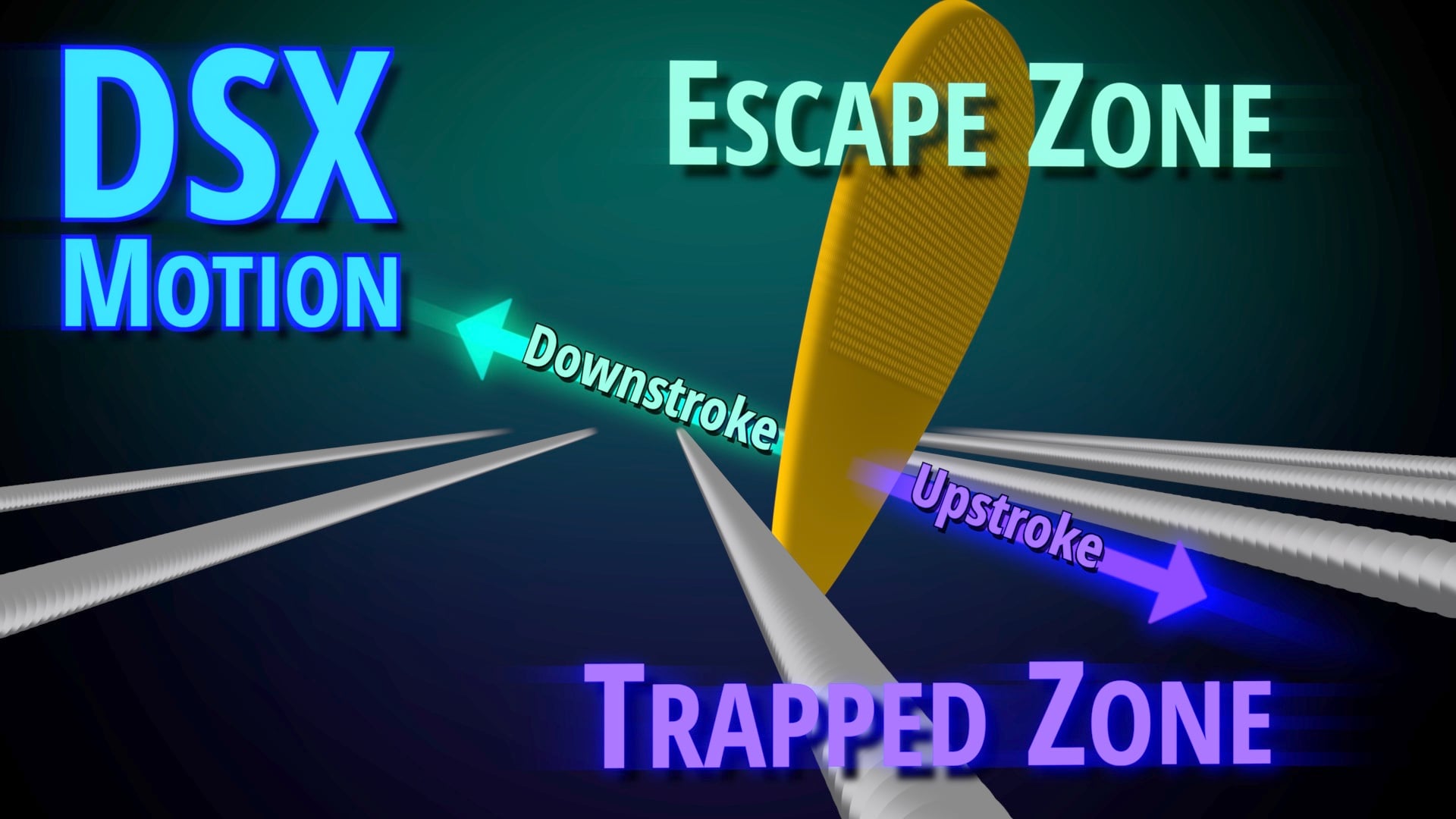
In a downstroke escape or DSX motion, the downstroke is the escape stroke and the upstroke is the trapped stroke.

This makes DSX motion the mechanical inverse of USX motion, tracing a diagonal path that appears to be tilted the in opposite direction:

To switch strings efficiently with DSX motion, the final note on every string needs to be a downstroke. Thanks to the angled trajectory of the motion path, downstrokes rise up in the air and escape the strings, letting you drop down to continue picking on a different string with no significant loss of efficiency:

This is the same string switching capability offered by USX motion, just with downstrokes instead of upstrokes. In fact, any phrase that can be played exclusively with USX motion can also be played exclusively with DSX motion by simply flipping the sequence of pickstrokes, so that new strings start on upstrokes and end on downstrokes, to capitalize on the escape.

DSX Motion And Pickslanting

Some DSX picking techniques require the use of upward pickslanting, where the pick is held so that it appears slanted away from the floor, toward the ceiling:

However the most common DSX techniques actually do not require this, and instead can be performed with a zero-degree pickslant. In these techniques, the pick moves along a diagonal escape path, but the arm position and pick grip are designed to work together to allow the pick to be held vertically:

The appearance of the pick (pickslant) and the path of the picking motion (escape) are different things. So to avoid confusion, in Cracking the Code, when we want to refer to a diagonal motion, where downstrokes escape, we use the term “DSX”. When we want to refer the appearance of the pick, where it appears tilted toward the ceiling, we use the term “upward pickslant”.

Whether UWPS or a zero-degree pickslant is required depends on the specific technique used. Because of this, it’s important to understand which specific version of DSX technique you’re trying to learn. Achieving the right result requires using the form that produces the correct pickslant (or not) for that technique.

DSX Players

Notable DSX users include fusion legends John McLaughlin and Al DiMeola, shred pioneer Michael Angelo Batio, and bluegrass and rock multi-instrumentalist Andy Wood. Here’s Andy playing a common six-note scale pattern in slow motion:

Gilbert Sixes Warp4

Video access level: Masters in Mechanics

Each time Andy moves to a new string, the pick simply glides over the top of the trapping string without hitting it. In fact, if you watch closely, you can spot several instances where Andy’s upstrokes actually contact, or rest stroke, against the next string lower in pitch than the one he’s playing. This confirms that they are indeed still trapped, even though the downstrokes are escaped.

This is how we know Andy’s motion is actually following the characteristic diagonal trajectory of DSX motion, where downstrokes move up in the air and escape. This diagonal trajectory is hard to spot if you’re watching Andy from traditional audience perspective, but becomes visible when viewed more closely down the strings:

Bluegrass Speed

In bluegrass, DSX motion is a kind of de facto standard for fast playing on both guitar and mandolin. David Grier’s high-speed alternate picking technique is based on DSX wrist motion, and the pronounced trajectory of his escaped downstrokes is especially obvious when filmed from Magnet perspective:

In bluegrass repertoire, many traditional songs typically played at faster tempos also feature fretboard arrangements which are specficially optimized for this type of escape motion. In DSX-optimized arrangements, notes are strategically positioned across strings to maximize the number of downstroke string changes, and minimize the number of upstroke string changes.

In this segment of the fiddle tune Fisher’s Hornpipe, you can see the diagonal trajectory of Andy Wood’s DSX wrist motion, facilitating the string changes through escaped downstrokes on every string:

These conventions are all the more amazing considering their widespread propagation among the traditionally self-taught players who learn them. By focusing on motion smoothness at speed, players learn to discard phrases that would require the mechanically expensive process of switching between multiple joint motions. Over time, they build up improvisational vocabularies that can be played at high speed almost exclusively with a single type of escape motion — DSX — all without being conscious of doing so.

Shallow Escape

You may also notice that the escape trajectory of Andy’s DSX motion is shallow, and relatively close to parallel with the strings:

By contrast, Joscho Stephan’s Gypsy-style USX technique generates a more vertical escape angle, making its diagonal path more easily visible:

This shallowness in escape trajectory isn’t specific to DSX motion per se, but rather due to the different arm orientations and joint motions these two players use. Joscho’s technique uses a flexed wrist posture, with a mix of wrist joint and forearm joint motion. In both Joscho’s and Marty Friedman‘s techniques, this particular form and motion combination tends to pull the pick out of the strings more vertically.

But Andy uses mainly wrist motion with a form similar to Al Di Meola’s, which generates a shallower escape with less clearance during the string change. When viewed from the typical audience perspective, Andy and Al’s DSX wrist motion, along with the USX wrist motion of Mike Stern, all just appear to move side to side like a windshield wiper. The diagonal escape of these motions isn’t easily visible until you get up close with a camera, and even then only when you watch in slow motion.

When we watch Andy play the six-note pattern in regular speed video, the shallowness of the escape makes it much harder to notice:

Gilbert Sixes Warp6

Video access level: Masters in Mechanics

As an example of just how much mechanical variety there exists in the world of picking motions, shred pioneer Michael Angelo Batio‘s famously clean lead technique uses a flexed wrist form reminiscent of the Gypsies, but actually generates a DSX pickstroke from that position:

DSX Motion

Video access level: Masters in Mechanics

Despite looking pretty different from the form used by wrist players like Andy, the result is a similarly shallow-escape DSX motion. Mike begins with the point of the pick below the D string, and from that position, the pick actually goes up, along a diagonal path that would take him right over the top of the G string if he kept going:

DSX Motion

Video access level: Masters in Mechanics

It’s not entirely clear which joints Mike is using to generate the motion, but the elbow appears to be at least one part of it. And the elbow is another joint that generates a shallow DSX motion. A textbook example of elbow DSX in action is Brendon Small‘s awesome technique. Seen here at normal speed, the pick’s motion above the strings is very hard to spot:

Gears Trem Melody Tk2

Video access level: Masters in Mechanics

Wrist and elbow motion are both common choices among DSX players. And because these joints all move in a plane that’s almost parallel to the strings, the escape motions of many famous DSX wrist and elbow players, from John McLaughlin to Vinnie Moore, can all be hard to see without the kind of closeup Magnet view we’re using in these examples. This is one of the reasons why escape motion as a general concept went unnoticed for so many years, even by the players who actually use it.

USX Motion

By

In an upstroke escape or USX picking motion, upstrokes break the plane of the strings and escape, while downstrokes remain trapped.

This produces a picking motion which doesn’t actually move side to side at all, but instead traces a diagonal path relative to the strings, where the upstroke portion of that path lies in the escape zone:

Because of its angled trajectory, upstrokes naturally rise up in the air, allowing you to drop down on a different string and continue picking. So to play a multi-string phrase with USX motion, the last pickstroke on every string must be an upstroke, so that all the string changes occur during the escapes:

When paired with phrases that are arranged this way, the alternate picking motion becomes the string switching motion. As fast as you can pick, you can also move to a new string, without any additional jumping motion and without any loss of speed or efficiency.

From an engineering perspective, this solution to the string-switching problem is pretty ingenious. And it’s remarkably simple, too. The motion still moves back and forth, just on a slight diagonal. When you trace the path this diagonal motion creates, the zig-zag pattern makes it easy to see how economical this solution is, moving the pick from one string to another without any jarring jumps or disruption in the smoothness of the motion.

USX Motion And Pickslanting

Almost all USX picking techniques require the use of downward pickslanting, where the pick is held so that the wider (top) part of the pick appears slanted toward the floor:

However, this is just one example of what downward pickslanting can look like in a USX picking technique. There is no universal method for achieving this orientation, and it is incorrect to assume that all USX techniques require a supinated or rotated arm to create the downward pickslant.

Instead the exact method a player uses depends on the specific USX technique they employ, and these can vary dramatically in the joints that are used and the form required. So it’s important to understand which USX technique you’re trying to learn. Achieving the right result requires using the form that produces the correct pickslant in the correct method for that technique.

USX Variations

Adoption of USX motion is widespread across many different musical styles, by players as diverse as Eric Johnson in rock and blues, Yngwie Malmsteen in metal, and George Benson in jazz. With one notable exception, variation in USX techniques stems mostly from the idiosyncratic mechanical choices of individual players, rather than requirements imposed by specific musical styles.

For example, the upstrokes in metal master Marty Friedman‘s technique follow a pronounced escape angle and are super easy to spot when viewed in slow motion:

Blues Dom11 - tk2

Video access level: Masters in Mechanics

By comparison, jazz icon Mike Stern‘s upstroke escape is much shallower, just barely clearing the trapped strings during string changes:

Picking Every Note Improv

Video access level: Masters in Mechanics

The difference in escape angle between these two USX players flows from the arm position and joints they’re using. Marty uses a supinated forearm orientation, and a unique combination of forearm, wrist, and finger joints to generate the picking motion. As a result, his upstrokes pull out of the strings almost completely vertically, making their escape path very easy to see. But Mike uses a much less supinated arm position, and a wrist deviation motion which moves side to side along a path that is almost parallel with the strings. So Mike’s upstrokes only escape by a few degrees, cutting it very close as he moves from one string to the other.

Note that whether the escape angle looks more vertical or less vertical has nothing to do with the efficiency or speed of the resulting motion. Marty and Mike are both moving the pick back and forth along an approximately straight line path. The reason one looks more vertical than the other has to do with how their arms and hands are oriented compared to the guitar they’re holding. If there is any difference in the efficiency of the picking motions of these two players, it would flow from the joint motions each player is using, and not from the escape angle we see under the camera.

The Gypsy Standard

Guitarists in most musical styles have historically been self-taught, at least as far as picking mechanics are concerned. As a result, players within any one style often exhibit a wide range of different mechanical approaches. But the Gypsy jazz style of Django Reinhardt is unique in standardizing on specific mechanics which are systematically taught to new players: USX motion.

In this slow motion example from our interview with Gypsy master Joscho Stephan, the diagonal trajectory of his USX pickstroke is easily visible:

Chromatic Asc

Video access level: Masters in Mechanics

Rock Gypsy

The pronounced escape angle of Joscho’s USX motion is similar to what we saw in Marty’s technique, which comes as no surprise, considering they both use a supinated form with a flexed wrist. Viewed together, the similarities are striking:

From our interview with Marty, we know that he was not trained as a Gypsy guitarist and only learned later in life, from watching video of himself as a teenager, that he was already using this form at an early age. The fact that he was not generally conscious of having chosen this approach may seem counterintuitive given how often fans have commented on its seemingly unorthodox appearance. But this is actually a common response among players we’ve interviewed. It is also one of the many examples of parallel evolution in guitar technique, in which different players hit upon similar mechanical approaches through trial and error, often while not being conscious of doing so.

As a result, Marty’s vocabulary includes many phrases with picking structure and fretboard layout similar to lines played by Gypsy guitarists like Django and Joscho, and his mechanics are subject to broadly similar requirements. When they’re not using downstroke sweeping, rock players like Marty and Gypsy guitarists like Joscho both achieve their fastest picking speeds by using pure alternate picking and ensuring that the last pickstroke on every string is an upstroke, to capitalize on the escape.

Escape Motion Reference

By

An escape motion is a type of alternate picking motion that moves away from the body of the guitar along a diagonal or semicircular motion path. This allows the pick to escape from between the strings during part of its travel.

Escaping is the principal method by which plectrum players avoid hitting unwanted strings during fast string changes. If a phrase is played with a picking motion that doesn’t have the right escape, it cannot be played cleanly at high speed no matter how much practice is applied.

So escape is not a motion itself, but an often overlooked property possessed by different picking motions that players already use. Cracking the Code’s interviews with picking pioneers like Michael Angelo Batio, Steve Morse, and Albert Lee represented the first systematic attempt to film and categorize the escapes that expert players use. Prior to this, escape motion was not part of mainstream stringed instrument instruction. The specific terminology we created to describe it — including the phrase “escape motion” itself — didn’t exist yet. For more background, you can read about that history here.

The good news is that most joint motions used in picking technique already possess some type of escape. For many players, this amounts to a freebie that can be unlocked simply by becoming more aware of the type of escape motion they already use.

In the next sections we’ll take a look at how escape motions work, which kinds are available, and which players use them.

The Problem of String Switching

By

Moving from one string to another is one of the most fundamental challenges in guitar picking. The need to do this efficiently is a requirement which exerts a profound influence on the types of picking motions that great players use.

Many players have difficulty executing lines that require picking across strings, although it may not immediately be clear to them why. They may hit wrong notes when they try to speed up. Or in some cases, they may not be able to speed up at all. A look at the geometry of picks and strings can help us understand what’s causing all the trouble.

Piercing The Plane

The strings on a guitar are arranged in a plane, such that when viewed in cross section, they form approximately a straight line. This is true even for guitars with radiused bridges, since the curvature of even an aggressive radius, like an old Fender, is still slight enough that it doesn’t really help with the trickyness this arrangement of strings creates.

To play a note, the point of the pick must descend far enough below that plane to make string contact:

When you do this, you’re positioning the pick in between two strings, right next to the one you want to play. The point of the pick is below the string height. Not by much, but below nevertheless. That’s how you can be sure that you’ll actually hit the string when you approach it.

From this orientation, you might imagine a picking motion that looks something like this, moving parallel to the string plane itself:

This hypothetical picking motion works fine for playing notes on a single string — the pick simply moves back and forth across the string, playing a note with each pickstroke. This is, of course, the alternating sequence of downstrokes and upstrokes we call alternate picking.

Trapped vs Escaped

But what if we want to move to a new string? Now we have a problem. Because if the pick’s point is low enough to play the initial string, then it’s low enough to hit the other strings too:

The point of the pick is still below the string plane, so moving too far in either direction will hit one of the surrounding strings, potentially sounding unwanted notes. The pick is basically trapped between the strings on either side of the one it is playing. And we already knew this, since we deliberatly positioned it between two strings to begin with.

I Want To Break Free

To move to a new string cleanly, we need to lift the pick out of the plane of the strings and escape, avoiding the strings that are trapping it. In other words, clean alternate picking across the strings can’t just be a motion that moves side to side. It must also, at some point, be a motion that goes up and comes back down again.

We don’t usually think about alternate picking as moving this way, but the logic is inescapable. If we don’t want to hit any of the strings that stand between us and the next string we want to play, we must escape. Figuring out how to do this efficiently, without hurting speed or fluidity, is the central challenge of string switching.

One obvious solution, like the sucker answer on a multiple choice test, would be to augment our side-to-side motion with a jumping motion right at the moment of the string change. But this turns out not to be what great pickers actually do. In fact, if you attempt this, you are likely to end up with the bouncy, tension-producing motion of stringhopping. Instead, the solution that the best players use is much more clever. And in the next section, we’ll find out what it is.

Olli Soikkeli

By

Olli Soikkeli’s tasty vintage stylings wouldn’t be out of place at a jazz age lawn party with linen suits and coupe glass cocktails. But when he fires up his 21st-century alternate picking technique, you’re about to take a ride in a DeLorean time machine of jazz guitar.

Olli’s blazing duets with Gypsy jazz stars like Joscho Stephan would already place him among the premier practitioners of that classic swing style. But when you take a close up look at his technique, you realize just how unusual that company is. Olli gets the sound, but he does it with alternate picking. This approach is less like Django’s storied rest stroke technique, and more similar to what you find at the elite levels of bluegrass guitar and classical mandolin.

It is perhaps this outsider perspective, both artistically and technically, that contributes to his unique sound. He has adapted and arranged dauntingly complex Brazilian Choro pieces by masters like Pixinguinha and filled them with a mix of influences from Django to the present. By deftly blending elements of European, American, and Brazilian jazz, he has created a voice that is as hard to pigeonhole culturally as it is historically.

In our interview, we get to the bottom of Olli’s awesome double escape alternate picking technique. Its semicircular curvature, clearly visible in slow motion, is what enables the arpeggiated leaps in challenging pieces like “Alumiando”, the duet with Choro master César Garabini that opens the interview. We discuss how Olli employs that technique while visualizing fretboard shapes for playing through changes. And we investigate his Gypsy-style strumming and tremolo techniques, which have also been adapted to his signature blend of old-time and modern sounds.

The full interview contains 102 musical examples, including complete transcriptions of “Alumiando”, arranged for both flat pick and seven-string Choro fingerstyle guitar, and Olli’s adaptation of Antonio Carlos Jobim’s haunting “Luiza”.

David Grier 2019

By

With an immediately recognizable voice that resounds through his signature arrangements of traditional tunes and original compositions alike, you always know when you’re listening to David.

And this is true even as that voice changes with different arrangements of the same song. In our latest meeting, we play four versions of the Monroe standard “Wheel Hoss” at various tempos, from a leisurely 180bpm eighth notes all the way to a blazing 300bpm. As the velocity increases, David’s arrangements become subtly more streamlined.

For his medium speed arrangements, he employs a double escape picking motion that enables intricate crosspicked sequences.  At higher speeds, his technique expands to include single-escape motions, letting him hit the gas pedal on more linear lines.  His trademark four- and five-string contrapuntal leaps are still present, but connected by a blazing fast lane of scalar playing.

In the complete talk, we also touch on topics in songwriting, practice, improvisation, and cap it off by playing through a pair of stunning new compositions from his latest album.

The one-hour interview includes 31 examples with tablature.

Brendon Small

By

When riffs, comedy, and storytelling collide, it’s time to prep for the Metalocalypse!

Rarely do so many skills grace the course of one career, let alone at the same time. And yet without this unlikely convergence of musical and cinematic creativity, the Metalocalypse might never have arrived. When it launched on Cartoon Network in 2006, the show was an instant hit. It was a lovingly calibrated satire of modern metal chronicling the disastrous exploits the fictional and yet all-too-real megaband Dethklok. The show’s pitch-perfect sendups of metal personalities rang immediately true, drawing a stream of enthusiastic leather-studded cameos from the likes of James Hetfield and Steve Vai.

But behind Metalocalypse’s arch parody was a seriously astute tribute to the music itself. The show’s animated visuals featured accurate instrument technique closeups as the band careened through a soundtrack packed with monster hooks and crushing guitar work that was good enough to stand on its own. This launched the virtual band into reality, as Brendon and a team of crack players brought Dethklok to life across three soundtrack albums and multiple tours.

In the Dethly Riffs interview, we dive into both the rhythm and lead techniques behind Brendon’s Dethklok and subsequent Galaktikon solo projects, tackling playthroughs of Dethklok’s punishing “Dethsupport” and Galaktikon II’s epic tremolo-powered “Icarus Six Sixty Six”. The technical talk investigates Brendon’s multiple approaches to fast thrash-style downstrokes, as well as a detailed examination of his intuitive command of single-note lead playing. We tease out the artful combination of wrist motions he uses to tackle three-note-per-string scales in the intensely rocking Paul Gilbert style. And we break down how those motions transition seamlessly to even faster elbow mechanics.

In the second conversation, Brendon takes us behind the curtain for a look at how Metalocalypse came to be. How do you fit Mark Hamill, Malcolm McDowell, and a coked-out rock and roll clown into 11 minutes of metal mayhem? Stay tuned to find out!

The three-hour interview set includes two song playthroughs and over 60 musical examples.