0

Join our list and get 5 free video / tab downloads!

The Synchronicity Seminar is here!

Identifying Elbow Motion

By

The elbow is probably the simplest of all the motion mechanics. It’s just a hinge that moves in two directions, flexion and extension.

It’s powered by the muscles in the upper arm including the biceps for flexion, and the triceps for extension:

Elbow Form

Setting up for elbow motion usually involves one of two distinct forms that you can learn to recognize, even from a distance. Brendon Small uses the straight form, where the forearm rests on the guitar body, and the forearm and wrist point in the same direction:

Picking pioneer Steve Morse also has an elbow technique for which he uses the straight form. Both Steve’s form and Brendon’s form use a pronated forearm, where the thumb side of the forearm makes contact with the guitar body more so than the pinky side:

From this camera angle, you can see the slight shadow beneath Steve’s arm. That’s the pronated orientation causing a very slight air gap on the pinky side of the arm.

Nylon string maestro Bill Hall uses the radial offset form, where the wrist bends slightly in the direction of thumb, in the radial direction. This makes the forearm and wrist look a little like a hockey stick:

Hyperpicker John Taylor also uses the radial offset form:

Elbow Motion

The defining characterstic of elbow motion is that the forearm and the hand move together as a unit:

Thanks to the way you have to reach over the guitar’s body while the shoulder remains behind it, this causes elbow motion to move slightly away from the guitar body on downstrokes. But you’d be very unlikely to notice this from the typical audience perspective, especially if you didn’t know it was happening.

Instead, when you view elbow motion from Magnet perspective, you’ll spot the angled path of DSX motion right away, where upstrokes point between the strings and downstrokes point into the escape zone:

Pickslanting

The escape trajectory is shallow, about 10 or 15 degrees relative to the strings. Very often you will find that elbow pairs with a similarly shallow upward pickslant. Here’s John Taylor’s 15-degree upward pickslant:

If edge picking is used and the grip is adjusted to accomodate this, there may be no appearance of pickslant at all. So try not to worry too much about looking for the slant of the pick to identify elbow motion. Instead, observing the macro elements of the forearm and wrist moving together is the simplest way.

As for confirming the DSX motion path, closeup video works best for that. But familiarity with the phrase being played is also helpful. If every string change is a downstroke, that’s usually an indication that DSX motion is being used.

Other Motion Types

The elbow doesn’t have rotational capability like the shoulder joint, or multi-axis capability like the wrist, so it can’t change the way it moves to create other escape types. It is effectively a DSX-only motion mechanic. However, just because you see motion at the elbow joint doesn’t mean it’s the only joint that’s moving. Zakk Wylde and Tommy Emmanuel are both USX players who appear to use motion at the elbow joint, but we suspect that these are actually blends, with another joint such as the forearm or perhaps even the rotator cuff pitching in to create the upstroke escape.

Hyperpicking

By

Hyperpicking is a form of elbow motion with a distinct pattern of muscle activation capable of extremely fast motion.

In hyperpicking mode, named after the 1991 instructional video of the same name, the elbow can attain picking speeds in excess of 300 beats per minute sixteenth notes:

John Taylor Hyerpicking 360bpm

Video access level: Masters in Mechanics

Our laboratory tests with hyperpicking master John Taylor at the Unversity of North Carolina resulted in the fastest human motion ever measured in a laboratory setting:

John Taylor Hyperpicking Lab Test

Video access level: Masters in Mechanics

The secret ingredient of hyperpicking appears to be activation of the brachioradialis muscle, which is the bulge in John’s upper forearm obscured by medical tape. In hyperpicking technique, the brachioradialis is tensed along with the triceps, creating what players describe as a sense of vibration — or, as John likes to say, the “jiggle”. However unlike anatomical spasms, which are random, when measured via EMG, hyperpicking motion shows regular, uniform tradeoff between the contractions of these two muscle groups:

In other words, even if it may feel somewhat like an automatic vibration in actual practice, hyperpicking is actually a controlled joint motion. The regular nature of the motion is supported by John’s ability to synchronize it, measuring out uniform semiquavers even at extreme tempos where notes are no longer individually audible:

Motion Types

By

The elbow is one of the most common motion mechanics for DSX playing.

Using either the straight or radial setups, and holding the guitar flat against your body, the elbow generates a relatively shallow DSX motion path of about 10 or 15 degrees:

When viewed with the Magnet, elbow motion appears to move the pick in a straight line. Similar to viewing a dinner plate on its edge, the semicircular path of the elbow’s motion isn’t visible from this perspective.

USX Motion

The elbow doesn’t have rotational capability like the shoulder joint, or multi-axis capability like the wrist, so it can’t change the way it moves to create other escape types. It is effectively a DSX-only motion mechanic.

But when you see motion at the elbow joint, that doesn’t mean it’s the only joint that’s moving. Zakk Wylde and Tommy Emmanuel are both USX players who appear to use motion at the elbow joint, but we suspect that these are actually blends, with another joint such as the forearm or perhaps even the rotator cuff pitching in to create the upstroke escape:

We’ll need to do more work to determine exactly what is happening in cases like this. For now, we’d simply note that this motion exists, and it works fine for USX playing.

However, if your motion looks like this but feels awkward, speed-limited, or creates arm tension, it may be worth attempting an elbow motion using one of the two DSX forms. In our experience working with viewers, we’ve seen cases where this small switch was able to remove speed-limited awkwardness, even when the DSX form initially felt unfamiliar.

Trapped Motion

Finally an interesting twist involves not changing the elbow’s motion, but rather orientation of the guitar itself. If you tilt the guitar so that the treble strings are a little farther away from your body than the bass strings, you can line up the pick’s angled path of motion parallel with the strings. This will create trapped motion, so that neither downstrokes or upstrokes escape. This can be useful for utilizing the elbow’s speed and power for playing fast double stops or chords.

Function And Form

By

The elbow is probably the simplest of all the motion mechanics. It’s just a hinge that moves in two directions, flexion and extension.

It’s powered by the muscles in the upper arm including the biceps for flexion, and the triceps for extension:

Straight Form

Brendon Small’s elbow technique is a textbook example of one of the most common setups for elbow motion, with the forearm resting on the body of the guitar in a pronated orientation, and the wrist and forearm in relatively straight alignment:

Fusion pioneer Steve Morse, while better known for his intricate crosspicked lines, also has a very effective high-speed elbow mode that utilizes a similar pronated form with straight forearm-wrist alignment:

Radial Offset Form

Alternatively, look for the radial offset form used by Bill Hall. This is a slight bend in the wrist toward the thumb — in other words, in the radial direction — which makes the forearm and hand together look something like a hockey stick:

You’ll note this same form in hyperpicking master John Taylor:

Although the straight and radial forms involve slightly a different arrangement of the forearm and wrist joints, these joints are downstream from the elbow. So we don’t believe they change the shape or type of escape motion created by the elbow joint, which still moves back and forth along the same path in both cases.

Upward Pickslanting

Both of these forms require placing the arm against the guitar body while the shoulder remains behind it. This causes the arm to point away from the guitar on a slight angle, creating a shallow upward pickslant. Here’s John Taylor’s UWPS attack:

But introducing a little edge picking can dial out some or all of the pickslant without incurring the garage spikes problem. So observing the pick’s motion path, from upstroke to downstroke, is a much more reliable way of understanding how the elbow joint moves than looking for the “slant” of the pick, which may not be easily visible or even present.

Motion Mechanics

By

A motion mechanic is the joint or combination of joints you use to generate the picking motion itself.

Despite the seemingly endless variety of ways you can physically move a pick, the most common approaches actually fall into a few simple categories. We’ve already taken a good closeup look at them in our investigation of escape motion and pickslanting.

Different joints generate different types of escape motion. So for example, the elbow only does DSX motion when operating by itself, while the forearm mainly does USX. And even beyond that, these joints generate motion paths with unique shapes, which helps us understand which physical mechanic is being used even if we can’t clearly see how the arm or hand is moving.

In this section, we’ll take an in-depth look at how these important joints function. We’ll also provide some tips for learning to recognize them when you’re using them. This isn’t as simple as you might think!

Pickslanting And Sweeping

By

In sweeping, pickslanting is used to enable sliding in the direction of the sweep. By joining forces with alternate picking motions that use the same pickslant, you can unleash the power of economy picking.

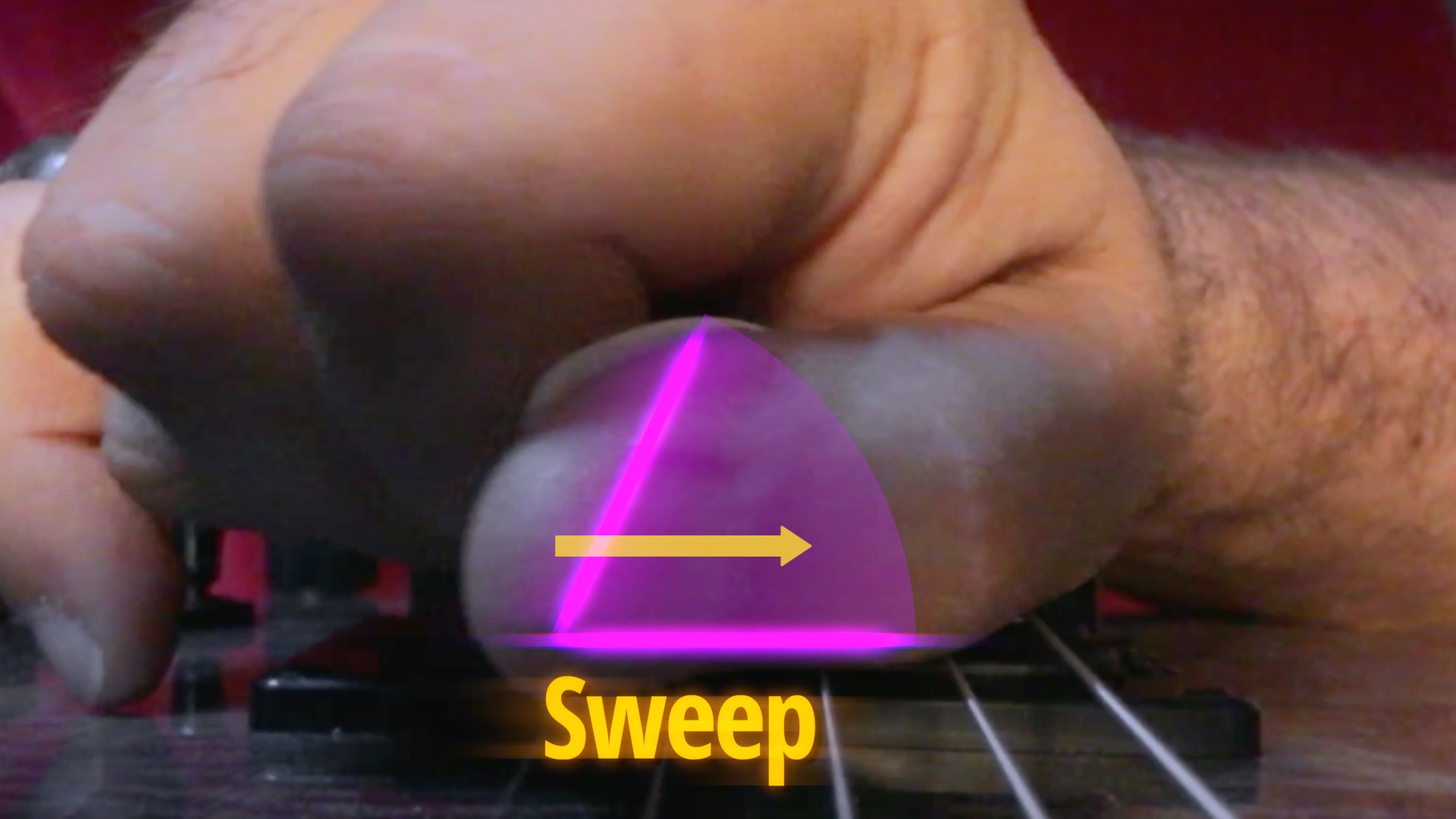
Sweeping is a trapped picking motion that moves across multiple strings, playing a note on each one. When you do this with a pickslant, the angle of attack this creates is less than 90 degrees:

In this example from sweep pioneer Frank Gambale, the upstroke sweep moves parallel with strings from left to right across the screen. The pickslant is UWPS, or upward pickslanting, so it slants to the right on the screen, the same direction as the sweep is moving. The angle between the two isn’t 90 degrees, but somewhat less, about 75 degrees or so.

So this is like the garage spikes problem, just the good half of the problem that promotes more sliding when the angle of attack is less than 90. If you tried to sweep in the other direction using the same pickslant, you’d run into the other part of the garage spikes problem, where the pick would dig under the strings and get stuck:

This is happening because the pickslant is incorrect for the direction we’re trying to go. To fix it, we just reverse the pickslant to DWPS:

This gives us a sub-90-degree attack in the downstroke direction, and we can now slide smoothly again. Combining UWPS and DWPS to promote smoothness in both directions like Frank does is an approach we sometimes call two-way pickslanting:

Technically speaking, pickslanting isn’t strictly necessary to achieve smooth sweeping. After all, we learned from alternate picking technique that an attack of 90 degrees works perfectly fine for both picking directions, downstroke and upstroke. However what we’ve noticed by filming great sweepers is that almost everyone uses some amount of directional pickslanting during sweeping, even if it’s slight. As an example, here’s shred pioneer Michael Angelo Batio executing his famously smooth five-string minor sweep arpeggios:

Arpeggio Sweep Hi Gain

Video access level: Masters in Mechanics

Mike makes a small adjustment to his form to promote two-way pickslanting, achieving DWPS on the downstroke sweep, and UWPS on the upstroke sweep. It’s tempting to think these small attack changes are simply caused by the force of the string pushing back against the pick. However you can see in the still frame of the video clip that Mike is already holding his pick in a DWPS orientation even before starting the phrase.

And if you watch closely, you can see that when Mike gets back to the bass strings to start the pattern over, he shifts the pickslant back to this DWPS orientation before even contacting the string. So these changes, however subtle, are actually deliberately learned joint motions, even if they can sometimes feel automatic to the player after so many years of doing them.

Economy Picking

Even though Frank is known for his sweep innovations, most of his signature lines actually qualify as economy picking, or phrases which combine alternate picking and sweeping together. Frank knows this and has dubbed his particular style of economy picking “Gambale Sweeping” to refer to his use of sweeping in both directions, together with alternate picking.

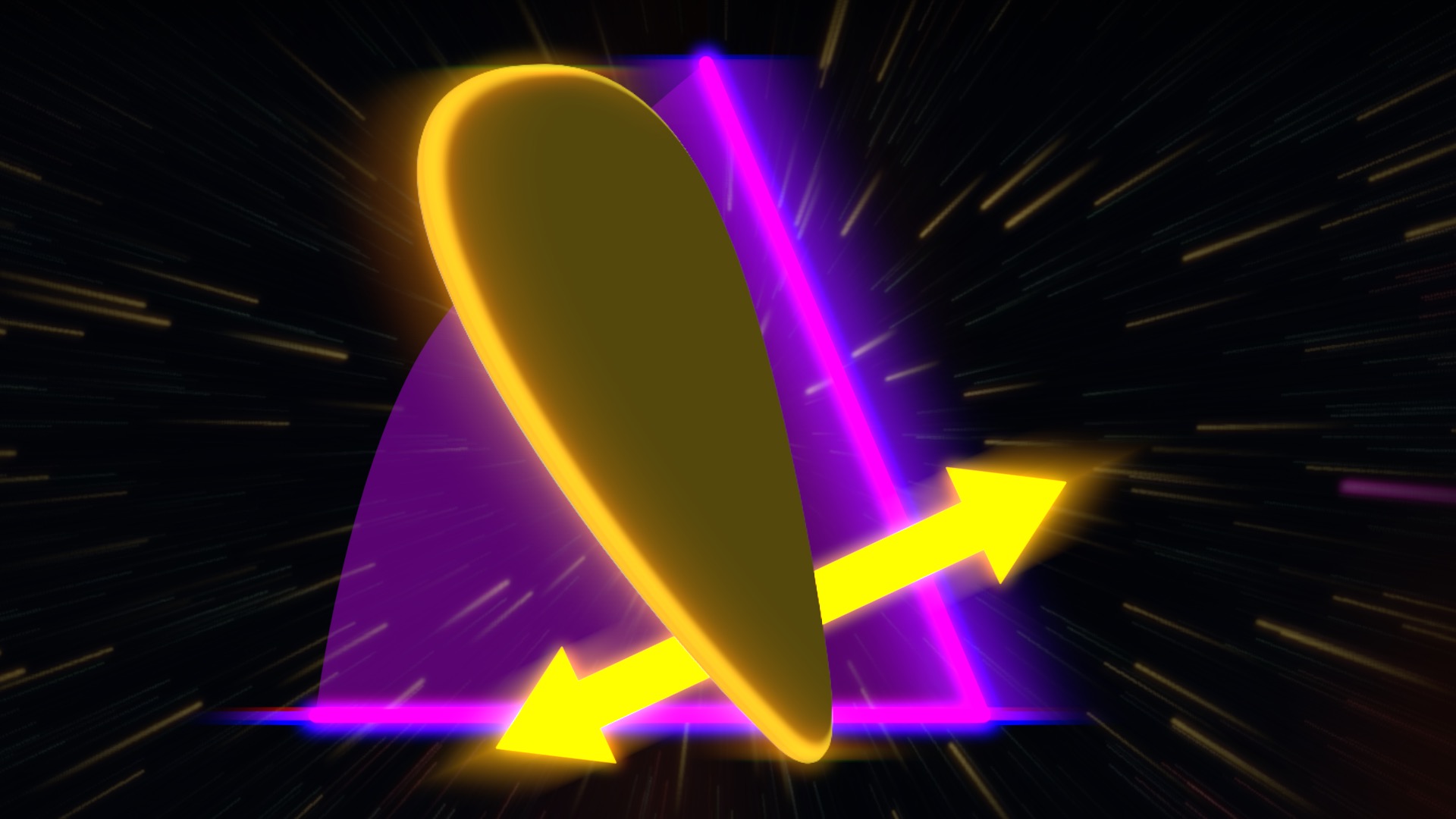
The way this works is extremely clever. To reveal it, let’s take a look at Frank’s use of upward pickslanting. Upstroke sweeps in Frank’s technique rely on upward pickslanting for smoothness, and so does his DSX alternate picking motion. In fact, these two motions don’t even move in the same direction:

As we can see above, sweeps move parallel to the strings, left to right across the screen, while the DSX alternate picking motion moves along a diagonal, from the upper left to the lower right of the screen. But they can both still use the same pickslant. So whenever Frank uses upward pickslanting, he can access both techniques, right inside the same phrase. This amazing mechanical coincidence allows Frank to combine these two picking motions together in all sorts of ingenious ways:

Edge Picking Improv Tk2

Video access level: Masters in Mechanics

This expertly crafted phrase is a cascade of overlapping patterns that flows seamlessly across the strings. Every string change is executed either via an upstroke sweep or an escaped downstroke. The two techniques complement each other perfectly. DSX picking motion can only switch strings using a downstroke, and upstroke sweeps can only move to a new string using an upstroke. So by combining the two, we attain the ability to switch strings using either pickstroke.

One Way vs Two-Way Economy

In this approach, the upstroke sweep allows us to economize on pickstrokes, playing two or more notes with the same trapped motion. So this phrase is an example of one-way economy, because it uses sweeping on only one pickstroke, the upstroke. We sometimes call this specific approach upstroke economy or UWPS economy.

The ingredients of upstroke economy are UWPS and DSX. If the abbreviations get a little confusing, just think about the two string changes you’re trying to make. Upward pickslanting gives you upstroke string changes through sweeping, and downstroke escape motion gives you downstroke string changes through alternate picking.

This formula also works in reverse to create another type of one-way economy. We can combine DWPS and downstroke sweeps with USX motion and escaped uptrokes. Here’s economy wizard Oz Noy playing an ascending arpeggio with this approach:

Arpeggio Major Ascending

Video access level: Masters in Mechanics

In slow motion it’s easy to see how Oz makes these two string switching techniques work together. He handles downstroke string changes with sweeping, playing two strings with one trapped motion. And upstroke string changes are escaped, rising up into the air to move to the next string unimpeded. This combination of DWPS and USX motion gives us downstroke economy or DWPS economy.

Finally, we can glue these two approaches together into two-way economy. Here’s Oz playing the arpeggio again in both directions:

Arpeggio Dominant Middle Shape Repeat

Video access level: Masters in Mechanics

Even without stepping through this example in slow motion, Oz’s expert use of two-way pickslanting is super clear. The ascending side of the arpeggio is DWPS economy, changing strings with a combination of downstroke sweeps and upstroke escapes. The descending side is the reverse, utilizing UWPS with upstroke sweeps and downstroke escapes. If you look at the pick while he’s doing this, it’s really easy to see the pickslant flip flop with each change in the lick’s direction.

It’s more confusing to write this stuff out than it is to actually do it! In fact, Oz himself explained that he never thinks about the motions he makes, even he as expertly demonstrated different intricate combinations on the fly in our discussion. This is good news. All these moving parts, including the sweeps that slide and the escapes that fly, work together so naturally that you can actually feel your way through even complex phrases like these once you learn how to perform the basic motions.

Zero-Degree Pickslanting

By

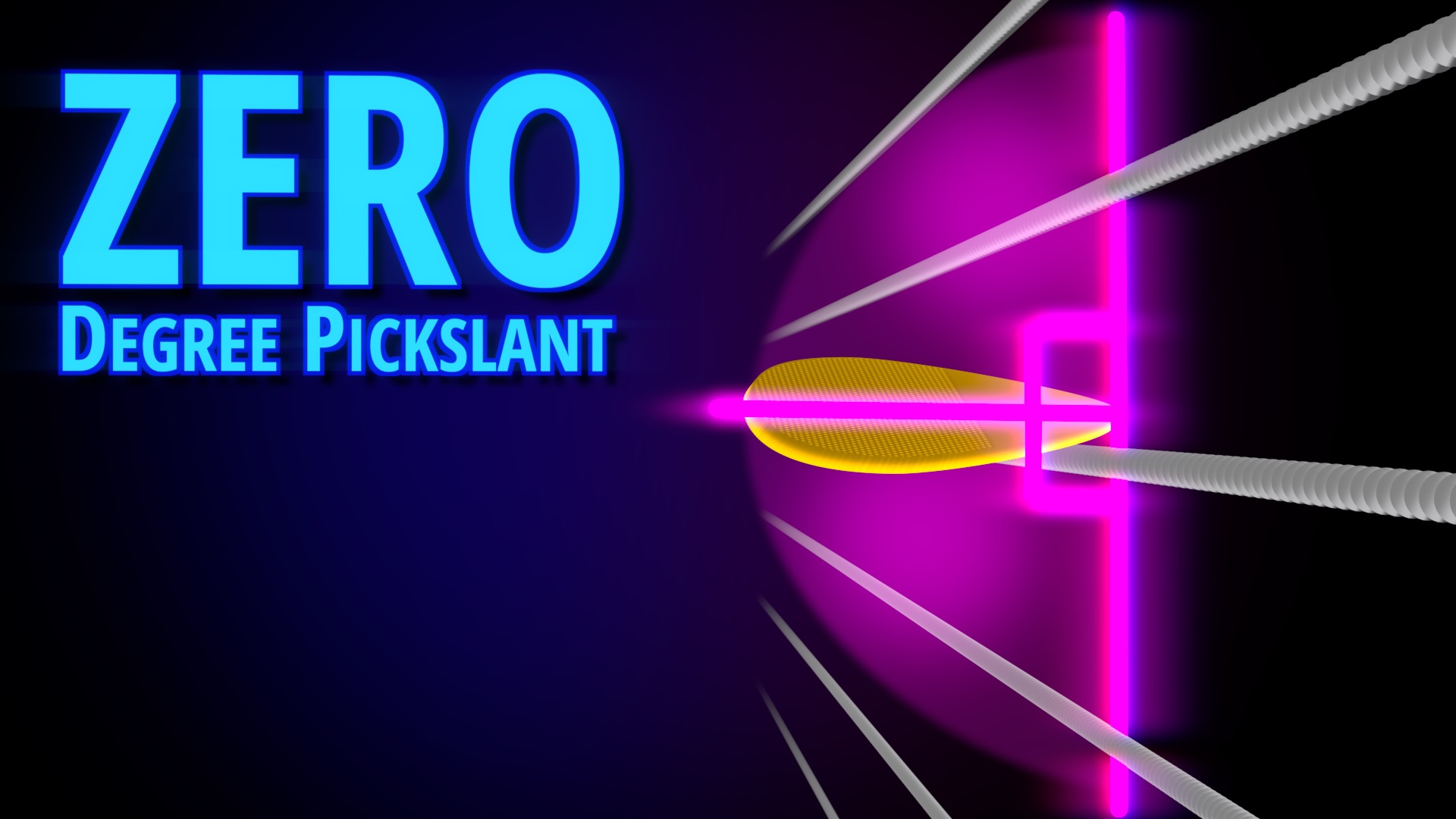
Zero-degree pickslanting is an orientation where the pick is held perpendicular to the plane of the strings, allowing for smooth attack during DBX and trapped picking motions.

An interesting application of the 90-degree rule occurs in the case of double escape motion. After all, this is a curved motion, so how do we know which pickslant matches with that? Here’s David Grier’s form for DBX wrist motion:

The difference between David’s DSX form and the DBX form we’re seeing here is easily apparent. Instead of an angled motion with an upward pickslant, double escape motion traces a shallow semicircle while the pick remains vertical with respect to the screen.

The physics-style explanation for this is that objects moving in a circle are constantly changing their direction. At any given moment, the object is actually moving in a straight line tangent to its circular path. So when the pick hits the string, it’s at the bottom of that semicircle, where the tangent line is the plane of the strings. Hence, perpendicular to the plane of the strings is the pickslant we want.

From our interviews with great double escape players, they do appear to use pickslants close to zero degrees. Here’s flat pick virtuoso Molly Tuttle’s pronated forearm setup and zero-degree pickslant:

By comparison, players who use an approach with a supinated forearm, like Olli Soikkeli and Andy Wood, can sometimes appear to have a very slight downward pickslant during DBX motion:

Andy’s downward pickslant, while still slight, is perhaps a tiny bit more visible than Olli’s in this particular snapshot. You’ll also note that compared to Molly and David, who use a primarily flat attack against the string, both Olli and Andy use edge picking, with Andy using more.

This very small amount of downward pickslanting appears to be mainly a consequence of the supinated forearm position these players use, and doesn’t seem to have much of an effect on pick attack one way or another, especially when techniques like edge picking and grip flop are used for smoothing. For practical purposes, we can consider Olli and Andy’s DBX pickslant approximately zero-degree.

Upward Pickslanting

By

Upward pickslanting, or UWPS, is a picking orientation where the pick slants toward the ceiling. Its primary use is to ensure smooth pick attack during DSX motion.

In a DSX motion, downstrokes are the escaped pickstrokes, rising up into the escape zone above the plane of the strings. This motion type is the mechanical inverse of USX, so the pick orientation we need to restore our 90-degree angle of attack is now an upward pickslant, or UWPS:

In bluegrass master David Grier’s high-speed DSX picking motion, he uses a pronated setup in which the forearm is rotated toward the bass strings. This has the effect of rotating the hand and the pick along with it, producing the very visible upward pickslant we’re seeing here.

Paired with David’s choice of deviation wrist motion, this creates about a 30-degree escape angle, approximately the most vertical escape — and the most visible pickslant — we typically see among DSX techniques. It looks very similar to sweep master Frank Gambale’s DSX technique when he uses his pronated form, and the two pickslants appear remarkably similar when lined up alongside each other:

Other DSX approaches generate a more shallow escape. One of the most common is the type of wrist motion used by Brendon Small, based on a lightly supinated forearm instead of a pronated one:

Brendon’s wrist technique produces an escape angle of only about 15 degrees. As such, you’ll notice that the slanted picking orientation is much less obvious, and might not be noticeable at all without the “down the strings” camera angle we’re using here.

Another common DSX motion with shallow escape is elbow motion, a technique Brendon also uses:

When the elbow joint is used for alternate picking, it produces a DSX motion with an escape angle of approximately 15 degrees, similar to Brendon’s wrist-based DSX technique. The matching 15-degree pickslant is also subtle compared to the more visually obvious pickslant of David Grier’s DSX technique.

This tendency toward shallow escape is not strictly linked to DSX motion itself, but instead a function of the specific body position and joint motion that we’re seeing here. But because these happen to be popular choices, some of the more famous DSX techniques in history, like those of John McLaughlin and Al Di Meola, may not appear upon casual observation to use pickslanting, even though they do.

Pickslanting And Edge Picking

Another reason why “looking for the slant” is not a reliable indicator of what kind of picking motion a player is using has to do with edge picking.

When you introduce edge picking, some part of the pick’s edge strikes the string, promoting sliding. This allows you to use a pickslant that may not precisely match the angle of your motion. A great example of this is Andy Wood’s DSX technique, which sometimes doesn’t appear to use a pickslant at all:

Andy’s style of DSX wrist motion is similar to Brendon Small’s in that it generates a shallow escape angle relative to the strings. But it’s still an escape motion, and still angled, so we’d expect to see some amount of upward pickslanting here. The reason we don’t is that Andy, like Brendon, uses a high degree of edge picking. This lets him slide over the strings in both directions, avoiding the garage spikes problem, even though his angle of attack isn’t quite symmetrical.

The combination of edge picking and relatively little pickslanting is common in DSX motion, but it’s not unique to it. The same relationship combination also works for USX motion, where a high degree of edge picking can still promote smooth pick attack even when the motion is angled:

In this Mike Stern-style approach, the tapered shape of the Jazz III pick, combined with a high degree of edge picking, promotes sufficient sliding and smooth-sounding attack. Once again, the key to this relationship is shallow escape. Andy’s technique, Brendon’s technique, and Mike’s technique can all use less of a pickslant because the motion is almost parallel to begin with. So all it takes is a little edge picking to smooth out the attack.

So if you’re looking for a way to identify picking techniques from more than a few feet away, the best way is not to look for the pickslant, but the type of picking motion itself. The general form of a common DSX approach like elbow motion is easy to recognize, and is a much more reliable indicator of the type of escape motion a player is using than trying to to judge the appearance of a pickslant which is very slight or possibly even not there.

Downward Pickslanting

By

Downward pickslanting, or DWPS, is a picking orientation where the pick slants toward the floor. Its primary use is to ensure smooth pick attack during USX motion.

In a USX picking motion, the pick does not move parallel with the strings, but instead along a diagonal pathway where upstrokes move into the escape zone. To compensate for this angled motion, the pick needs to slant the opposite way — downward — to restore our symmetrical, 90-degree pick attack:

There are lots of ways to do USX motion, using different pick grips, arm positions, and joint motions. While they are all similar in allowing upstrokes to escape, these motions can look pretty different. We’ve already looked at Marty Friedman’s USX form and noted its similarity to the Gypsy picking form of Joscho Stephan:

Both Joscho and Marty’s forms are based on a supinated arm position and flexed wrist. This is a very common USX playing position, and it generates an escape angle of around 35 degrees. As a result, both players also use an easily visible 35-degree downward pickslant to maintain smooth attack:

By comparison, Mike Stern’s USX technique uses a less supinated arm and a wrist-based picking motion. Mike’s escape angle is only about 10 degrees, and his matching 10-degree downward pickslant is visually much closer to perpendicular:

In general, wrist motions like Mike’s tend to move closer to parallel to the strings and produce shallower escape angles than motions like Joscho’s and Marty’s, which incorporate the forearm joint and escape more vertically. This is just the way these joints move, since they operate in different planes.

There is no mechanical cost to pickslanting, and less pickslant is not better than more. In some sense, there really is no such thing as “less” or “more” pickslant anyway, since the end goal is always to end up with a pick attack of exactly 90 degrees relative to the picking motion. Just as we discovered when we looked at Frank Gambale’s technique, when we rotate the camera to straighten out Joscho’s pickslant, we find that his picking motion really does just move perpendicular to it:

So even though these techniques may look superficially different, as far as the motion of the pick is concerned, they are all essentially oriented straight up and down and moving side to side — and it’s the guitar that’s slanted!

Pickslanting Reference

By

Pickslanting is the practice of orienting the pick perpendicular to its direction of motion, so that pick attack is smooth.

By now we’re starting to become comfortable with the amazing fact that picking motions don’t only move back and forth. Most picking motions actually move diagonally or in a semicircle. When this happens, the process of pickslanting produces a corresponding angled orientation of the pick so that its attack can remain symmetrical between downstrokes and upstrokes despite the angled nature of the motion path.

In this section we’ll see what pickslanting looks like and how it’s achieved with different types of picking motion.