0

Join our list and get 5 free video / tab downloads!

The Synchronicity Seminar is here!

Magnet Maintenance

By

Constructed from a small number of high-quality parts, the Magnet will provide years of service with only minimal upkeep. Here’s how to keep your Magnet tuned up.

Magnet Construction

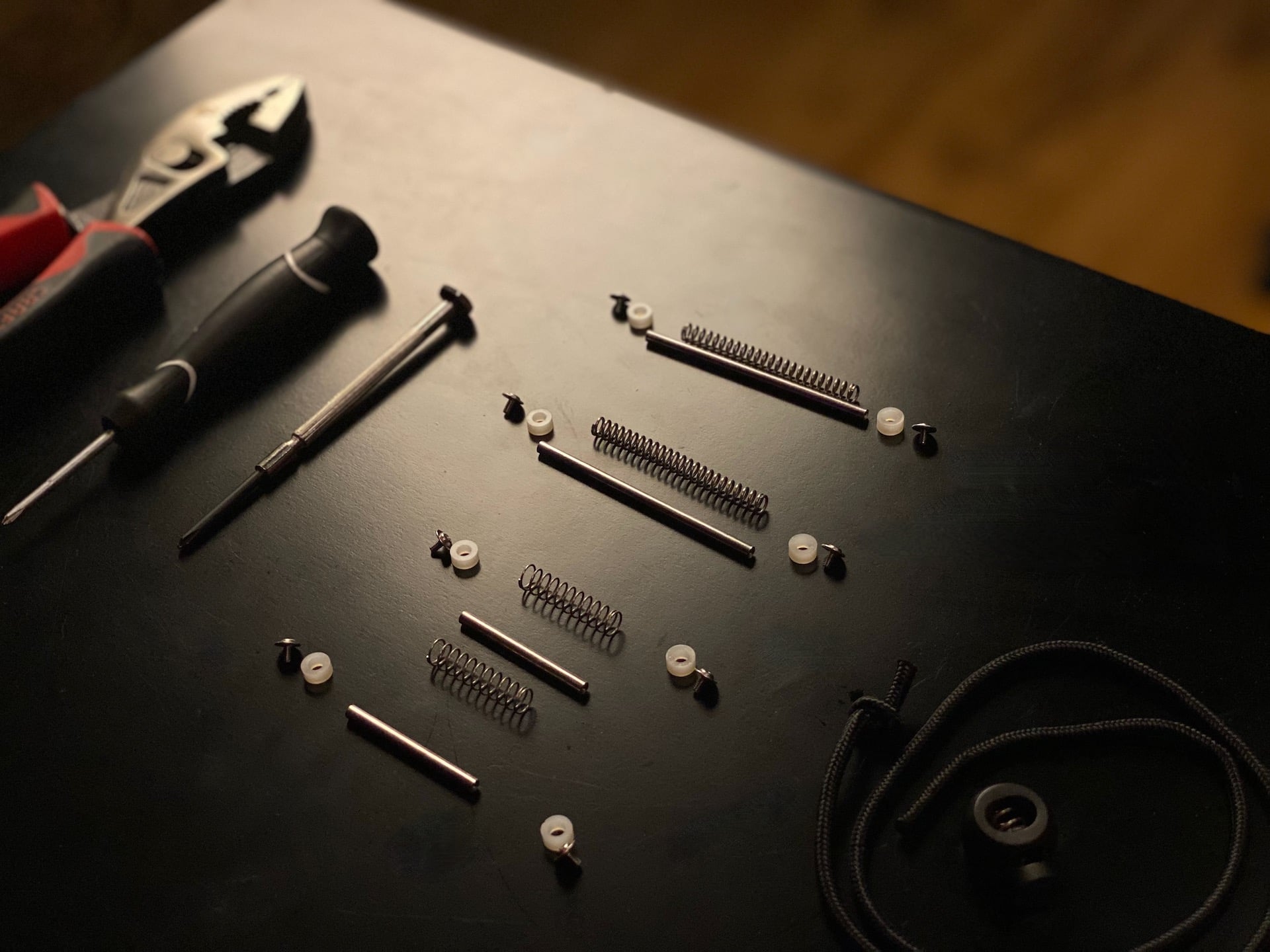
This is what’s inside your Magnet, along with the few tools you’ll need to completely disassemble and reassemble it.

The core of the Magnet is an arch constructed of four interlocking sections. The injection molded body is made from durable ABS plastic with overmolded TPE rubber grips.

The Magnet’s dual-axis expansion is powered by four spring-loaded rods: one long rod in each upper arch, and one shorter rod in each foot.

Each rod is a high-quality steel part, tapped and threaded at each end for a washer-head screw. In between are two nylon washers and the spring.

Magnet Lubrication

Is your magnet a little sticky when opening and closing to insert the phone? You might not notice this when operating the Magnet by itself, but when mounted on the neck, you may find that the Magnet doesn’t snap closed as quickly. This is due to chafing of the sliding surfaces, causing rough spots. The good news is that lubrication will take care of this quicky.

Don’t use oil-based lubricants like WD-40, to avoid reacting with the Magnet’s plastic. Instead, use a silicone lubricant. We use Super Lube, along with these handy squeeze-bottle applicators. Super Lube has a slightly viscous quality which clings to the parts, but still flows and coats easily.

First unscrew and remove the lower rods, and pull the two Magnet halves apart. You can leave the upper rods in place. Then coat the inside sliding surfaces of the feet with a thin layer of silicone lubricant and wipe off any excess. When reassembled, you should notice excellent snap-back, even when mounted on the neck. For max phone grip, don’t skip the “squeeze” step after the phone is inserted.

Magnet Rod Installation

Got a screw loose? Never fear! The screws may occasionally loosen through normal operation. This is not a sign of stripped threads — the rods and screws are high-quality steel parts and are not likely to fail. A little tightening and you’ll be back in action. Here’s how:

A pair of size zero (#0) screwdrivers is all you need to tighten a loose screw or reinstall a spring-operated rod. Pliers are optional for extra tightening, but not likely necessary.

If a rod becomes loose, don’t panic! Simply remove it, and start by installing a screw at one end.

Finger-tight is probably ok at this point, because we’re going to tighten both screws again later. But if you like, grab pliers to hold the rod in place and tighten the screw with a screwdriver.

Next, slide a washer onto the rod.

And now slide on a spring until it meets the washer.

Each rod channel has two openings, one on either side of the Magnet. Locate the deeper side, which will accommodate the spring. In this example, the correct deeper opening is actually on the shorter segment of the arch, just below the seam.

Slide the rod into the channel with the washer end on the outside.

To join both halves of the Magnet, the rod must pass through a small opening in the center of the channel. This almost never happens on the first try, leaving the washer end protruding.

Never fear! Rotate the Magnet so the channel is vertical, and jiggle the Magnet side to side a few times. If you perform the Jiggle Trick™ correctly, the rod should drop all the way into the channel. This is what the rod looks like when it is fully seated.

Grab one of your screwdrivers and insert it into the screw head like you are going to tighten it. Keep pressing against the spring tension until the rod sticks out out the other side of the Magnet.

To immobilize the rod in this position while fighting spring tension, just grab the Magnet with your fingers while palming the screwdriver handle. A screwdriver with a fatter grip makes this even easier.

Now install the second washer…

…and finger-tighten the second screw.

Use your free hand to grab the second screwdriver and tighten the second screw. If your first screwdriver is still correctly threaded in the first screw head, the second screwdriver will tighten both screws at the same time.

That’s it! Repeat this process for as many rods as you need to install. When you’re done, open the Magnet a few times to make sure it’s working smoothly.

Using The Magnet

By

Thanks so much for picking up a Magnet! We spent years designing and using the Magnet in our interviews and lessons, and we’re thrilled to bring this powerful tool to musicians everywhere.

Grab your guitar, mandolin, bass, bouzouki, oud, or just about any other plucked instrument, and fire up your smartphone. You’re just a few steps away from getting a perfect, close-up look at your picking technique.

If you have a question that you don’t see answered here, just send us a note at support@troygrady.com.

Cracking The Code: Our History

By

From a chance discovery about efficient instrument technique, a decades-long journey of musical and mechanical discovery was launched. Here’s how Cracking The Code came to be.

Picks, Strings, and Videotape

The unintentional Rosetta Stone

Cracking The Code began in 1991 at, of all places, Yale University. With Yngwie Malmsteen’s infamous REH instructional video on seemingly continuous repeat in the background of a Timothy Dwight dorm room, concerted fumbling with a pick and an Ibanez Roadstar Series 240 guitar lead to a startling accidental discovery. Yngwie’s vaunted alternate picking technique wasn’t just a side-to-side motion of the pick, but rather a diagonal one. By picking along a trajectory that allowed upstrokes to move away from the guitar’s body, he could move from one string to another at any speed, with very few mistakes, so long as the final pickstroke on every string was an upstroke.

The observation solved one of the thorniest mechanical questions surrounding playing a stringed instrument with a pick: namely, how you move from one string to another without hitting the surrounding strings. Not only that, but the realization that Yngwie was almost exclusively favoring phrases with this seemingly unusual “upstroke as the last pickstroke” design flew in the face of everything we were taught about how elite guitar technique is supposed to work.

Dot Matrix Shred

An independent study outlining this discovery was soon underway. Under the supervision of Andrew Leonard in the guitar department, the result was a 48-page manuscript introducing concepts like pickslanting and stringhopping. Both were breakthroughs in understanding one of the most common solutions to the problem of efficient string switching, and neither were yet part of mainstream guitar instruction.

Same mechanics, fewer pixels!

The paper also applied the concept of chunking, drawn from psychology research on memory and learning, to the problem of hand synchronization during high-speed playing. This part was actually a coincidence. Chunking was already employed by motor learning researchers to describe how complex sequences of motions are encoded and recalled. But we didn’t find that out until years later, in our interview with Pietro Mazzoni from the Motor Performance Lab at Columbia University.

Filming The Impossible

THE SHREDCAM: The Basler a602fc color Firewire camera observes the fearsome Rusty Cooley.

The paper raised more questions than it answered. If players at Yngwie’s level were doing things like this, what else might they be doing? Wouldn’t it be amazing to get a close-up look at real, live expert players, to see what other tricks they might have up their sleeves? But that would have to wait for technology to catch up. It eventually did, in the early 2000s, with the advent of affordable high-speed digital cameras.

The idea was simple enough: build a system that could film picking motions which are too fast or too small to see with the naked eye. After two years of after-hours coding and testing, the initial rig, affectionately referred to as the “ShredCam”, was born. It was a computer-controlled FireWire camera intended for industrial and scientific applications. It attached to the guitar body pointing at the player’s picking hand, and could output high-quality uncompressed Bayer pattern video at hundreds of frames per second. This was way beyond the speed of consumer cameras of the time, and fast enough for the most terrifying human guitarists.

The incomparable Steve Morse gets suited up with the first version of Cracking the Code’s high-speed camera rig.

Somehow, an array of incredible players agreed to attach this crazy contraption to their guitars while playing impossible phrases. This series of interviews included picking pioneers like Michael Angelo Batio, Rusty Cooley, Steve Morse, and Albert Lee. The rig even traveled all the way to Winfield, Kansas, to film bluegrass virtuoso Carl Miner at the famed Walnut Valley Festival National Flat Picking Championships.

The footage we captured was nothing short of amazing. It marked the first systematic attempt to film elite players up close, to understand and categorize the different escape motions they make. This focus on fieldwork continues to be a defining element of what we do today. To share clips of the interviews, the project also gained its first web site, and a placeholder name which ended up sticking around: Cracking The Code.

The Motor Learning Mystery

One of the most surprising things we’ve learned in our interviews is how self-taught virtuosos learn complex picking techniques.

For example, the sequence of upstrokes and downstrokes that elite players choose is not random, and not purely a matter of personal preference either. It’s based on fundamental differences in their mechanics. A player with one type of picking motion might need to terminate each string with an upstroke, like Yngwie did. Among our early interviewees, Mike Stern turned out to be one such player. But other players might only reach maximum efficiency when finishing each string with a downstroke. Michael Angelo Batio was one of those.

The amazing Michael Angelo Batio as seen from the Basler 602fc scientific camera

Prior to Cracking The Code, it was not widely known that choosing a different type of joint motion might require a different sequence of pickstrokes on each string to avoid awkwardness and errors. The technical explanation for this, and advice for what to do about it, were simply not part of mainstream guitar teaching.

But the players we interviewed were different. Their vocabularies contained a high proportion of picking patterns that could be played efficiently with their core mechanics — more so than you’d predict from random chance alone. How did they know this was necessary, and why weren’t they talking about it? Was it a conspiracy, to keep the rest of us from learning their secrets? The interviews answered that question clearly too: Amazingly, they were mostly doing this subconsciously.

Subconscious Streamlining

The incredible Mike Stern in his original Cracking The Code interview

Over years of practice, the best players learn to gradually weed out problematic picking patterns in favor of ones that feel the smoothest and sound the most accurate. Eventually, their vocabulary becomes dominated by phrases that match their motion type, even if they’re not aware of developing these preferences. This subconscious feedback loop is the core of how complex motor skills are learned, from throwing a ball to riding a bike.

Listening to Mike Stern’s famously inventive blend of rock and bebop, it is hard to imagine there is anything he couldn’t play with a pick. It’s even harder to believe that his accuracy is based in part on unconsciously avoiding phrases that are likely to be inaccurate with his mechanics.

Mike’s upstroke escape picking technique from ShredCam perspective

And yet Mike’s lines contain an unusually high percentage of picking patterns which can be played with what we call “upstroke escape”, or USX picking motion. Rather than being limited by this, Mike is simply a great example of a world-class player whose technical skills evolved to complement his musical choices.

The power is knowing this. When you realize that a beginner can dramatically speed up the learning process by doing something similar — intentionally avoiding specific phrases that can’t be played efficiently with their current technique — well, that would have blown minds in 1986.

Technique Taxonomy

When Cracking The Code began, the terminology we use now didn’t exist yet. So we introduced our own vocabulary for things we were seeing with our cameras. The terms we created, including escape motion, pickslanting, stringhopping, edge picking, swiping, and more, describe things players have always done, and either haven’t had a convenient way of explaining, or were simply unaware they were doing. This eventually grew to so many concepts that it amounts to a new, more structured way of thinking about guitar playing skills. Odds are good that if you’ve searched for information about developing effective picking technique, you’ve already run across players discussing their playing using our Cracking The Code terminology.

Evidence-Based Teaching

Modern camera gear offers a quantum leap of clarity in viewing Andy Wood‘s awesome technique

Here’s the problem with teaching: good advice isn’t good because it worked for one player, or because a famous person said it. It’s good if it reliably produces better results than you can get by accident.

And the only way to know that is to test it.

So we didn’t stop at research. We’ve taken everything we’ve learned and combined it with extensive testing and round-trip player feedback in our community. We’ve reviewed thousands of user-submitted video clips of their own playing to weed out which of our advice produced good results and which didn’t.

We then turned around and used this information to create simple and effective methods for diagnosing your own technique and learning new ones. Our core instructional product, the Pickslanting Primer, is updated constantly as our knowledge improves. We’re continually adding to our in-depth seminars on specific musical subjects. Our goal is to make learning effective picking technique as painless and approachable as possible.

About Cracking The Code

By

At Cracking the Code, we apply evidence-based methods to musical teaching, to help guitarists master technique and unleash their creative freedom. We pioneered many of the concepts that are now used by players around the world to understand and perfect their picking technique.

Prior to Cracking the Code, it was not widely understood that expert players use specific joint motions to switch strings with accuracy at high speed. We revealed this phenomenon in 2014 with our groundbreaking Cracking the Code dramatic series, and in our continuing in-depth interviews, analyses, and technical features on well-known players.

Along the way, we introduced an array of new terminology, including escape motion, pickslanting, two-way pickslanting, stringhopping, edge picking, swiping, and more, to describe techniques that were once learned largely subconsciously by self-taught picking pioneers. These techniques, and the language we created to describe them, were simply not part of mainstream stringed instrument instruction until we began teaching them publicly.

Team

Who’s responsible for all this awesome stuff? This is us:

The Cracking The Code Team

Meet the team behind Cracking the Code


History

To put it simply, by 2014 there was still no instructional video you could watch or guitar lesson you could take to learn why Yngwie Malmsteen favors lines that contain an even number of pickstrokes per string when he’s alternate picking. Similarly, there was no guitar magazine you could read to learn why John McLaughlin, mysteriously, heavily favors phrases where the final pickstroke on every string is a downstroke — even supposing you noticed this strange detail in the first place. These seemingly idiosyncratic preferences turn out to be mechanically linked to the techniques of these two revered players in such a way that mere mortals all around the world were suddenly able to tackle their phrases once they knew why.

Learn how these breakthroughs came to be:

Cracking The Code: Our History

How Cracking The Code Came To Be


World-Class Interviews

Our groundbreaking series of interviews with incredible players is the first systematic attempt to understand and categorize the different picking motions great players make. We use slow-motion video to film techniques in action with an unprecedented degree of close-up detail. In many cases, this allows us to film motions that the players themselves are not aware they are making. And in at least some of these cases, we’ve captured footage of techniques that simply weren’t filmable without tiny high-speed video cameras, and most likely hadn’t been seen in such detail before, if at all. Our interviews are documented with exhaustingly detailed transcriptions in Soundslice:

Interviews

Conversations with elite players and researchers


World-Class Instruction

We didn’t stop at research. We’ve used everything we’ve learned to create simple and effective methods for diagnosing your own technique and learning new ones. On the site, you can dive into our instructional products like The Pickslanting Primer, our core instructional guide to learning picking motions, and watch our longer-form Seminars on specific musical topics:

Pickslanting Primer

Cracking the Code's guide to learning picking motions


Seminars

In-depth multi-chapter investigations of select musical topics


World-Class Analysis

Our original 2004 slow-motion camera rig was a computer-controlled contraption of mounting arms and wires that let us film instrument technique in a way that had not been done before. When smartphones first acquired slow-motion capability in 2013, we responded by creating a custom phone mount for guitar, The Magnet. We used Magnet prototypes for years as a critical component of our interviews with great players. We delivered the first production-run Magnets to Kickstarter backers in late 2022. The Magnet goes on sale for everyone in 2024:

The Magnet: Smartphone Camera Mount For Guitar

The best camera mount for filming picking technique


World-Class Feedback

Subscriptions also include Technique Critique, a collaborative review of your playing by our team of instructors. Our unique team-based approach to teaching mechanics applies our collective experience and data gathering to the problem of making you better:

Technique Critique

Get personalized feedback on your playing from instructors and community members


The forum is free, and filled with a wealth of playing and experience and knowledge. All you need is a basic account on the site:

Great! How Do I Get Started?

Products like the Primer, Seminars, and Interviews are available via subscription or download. The download version offers lifetime free updates, as well as lifetime access to the web versions of all these products. But the web versions are actually the better versions. They include reference sections unlike anything in any other instructional product, that mix printed content, video clips and images that aren’t technically possible to download. They also contain additional features like timestamped tablature examples powered by the awesome Soundslice player.

A Cracking The Code subscription offers unlimited access to all this amazing stuff, including all instructional products and interviews. When you’re ready to dive in, check out our signup page: