0

Join our list and get 5 free video / tab downloads!

The Synchronicity Seminar is here!

DWPS Economy

By

Combining USX motion, downstroke sweeping and downward pickslanting creates one of the most popular picking styles of all time.

By now we’ve examined different ways you can create USX picking motion. And we’ve also looked at the mechanics of how pickslanting and sweeping can work together. When you combine these three ingredients, you arrive at one of the most widely-used picking styles in guitar: downward pickslanting economy.

DWPS economy is a one-way economy picking style because it utilizes a single direction of sweeping — the downstroke sweep — to economize specific string changes. So in the DWPS economy style, sweeps only move in one direction, but alternate picking can move in both directions, provided the final pickstroke on each string is an upstroke.

Because USX alternate picking and downstroke sweeping are the only two motions available to DWPS economy players, phrases may require certain notes to be played with specific pickstrokes, to be left unpicked, or in certain cases to be removed entirely in order to maintain efficiency at high speed. This results in a set of similarities in the way DWPS economy phrases are structured that are consistent across players and musical genres.

USX Motion

In the DPWS economy system, USX motion supplies the primary continuous alternate picking motion. When paired with phrases that contain an even number of notes on every string, string changes are possible even at very high speed with no mechanical penalty:

Alternate Picking - Six-Note Pattern - Connected

Video access level: Masters in Mechanics

This common six-note pattern is a staple of single-escape picking thanks to its even-numbered groupings. When started on a downstroke as it is in this example, each upstroke rises into the escape zone, making for easy transition to the next lower string.

Even though the first half of this phrase occurs entirely on the E string, USX motion is maintained the entire way, so escape motion is generated even though it’s technically not necessary. There is no mechanical “cost” to doing this, since single escape picking motions are already about as simple as a picking motion gets. But there is benefit in that no change to the motion itself is necessary beyond simply relocating it to the desired string.

Downstroke Sweeping

Picking pioneer Yngwie Malmsteen is remarkably consistent in applying DWPS economy to his vocabulary of classically-inspired scales and arpeggios, and his signature phrases offer many illustrative examples of one-way economy design at work.

While Yngwie’s use of sweeping for arpeggio playing generated immediate interest in sweep technique in rock guitar, what was less known at the time was the critical role sweeping played in Yngwie’s scalar technique. In this example from his REH instructional video, Yngwie sequences a 10-note circular pattern through successive positions on the top two strings:

Yngwie Malmsteen REH Compound Lick

Video access level: Masters in Mechanics

Given the blazing speed of this phrase, it’s not obvious upon first listen that sweeping figures prominently in its execution. But slowing it down makes this particular economy component clearer. Let’s take a look at just the first iteration of the sequence:

Yngwie Malmsteen REH Compound Lick Pattern1

Video access level: Masters in Mechanics

Yngwie plays three notes on the B string, the third of which is actually a downstroke sweep that is also responsible for the first picked note on the E string. The sweep is necessary here because downstrokes are trapped in USX motion, and can only switch strings through sweeping — and only then when moving to a higher string. In this case, that works out conveniently, as the third downstroke of the phrase can simply push through to the next string:

So sweeping in the DWPS economy system isn’t just economical, it’s structural. While there is no doubt mechanical savings in allowing a trapped pickstroke to play more than one note, the real reason it’s being used here is because it is the only string switching option available. This has the significant benefit of simplifying the motions needed to play a notoriously complex sequence like a three-note-per-string scale.

In this sense, using the term “economy” to describe this approach is a little misleading, because it implies that playing these notes another way would simply require more work. But physical labor isn’t the problem — it’s complexity. We know that it’s possible to play scales efficiently with pure alternate picking, but we also know that relatively few players seem to do it well. So rather than making scales more economical, the primary benefit of Yngwie’s DWPS economy approach is that it makes the picking motions easier to figure out, with less trial and error.

Legato and Forced Upstrokes

The return string change highlights the specific role that unpicked or legato notes play in DWPS economy technique. Counting the tail end of the initial downstroke sweep, the complete picking sequence on the top string of the lick is down, up, down, up — one pickstroke short of the number of notes on the top string. So the fifth and final note on the string isn’t picked at all, but instead pulled off:

Like Yngwie’s use of sweeping for the first string change, the choice to leave the final note on the string unpicked is essentially predetermined by the available motions. If the note were picked, it would be a downstroke. And since downstrokes are trapped, they can’t switch strings. Conversely, there’s no way to make the last note an upstroke, since the previous pickstroke was already an upstroke and we can’t do two in a row. So the only remaining choice is to simply not pick the note at all.

Using either a pull-off or hammer-on as the final note on the string is a very common DWPS economy technique for ensuring the final picked note on a given string is an upstroke. In this example, this converts the number of pickstrokes on the string from odd to even, allowing Yngwie to return to the lower string using an escaped upstroke for maximum string-switching efficiency.

Fretboard Refactoring

Yngwie’s final mechanical tweak concerns the symmetry of the phrase itself. Specifically, the sequence ends with only two notes on the B string, omitting the middle note of the three-note fingering that he played on the way up:

Even though this results in the phrase having a metrically unusual total of ten notes, this seemingly unorthodox choice is once again grounded in mechanics. Much like his use of pulloffs, this is Yngwie’s way of forcing the final note of the sequence to be an upstroke. This ensures that the next iteration of the sequence will begin on a downstroke, maintaining the carefully constructed alignment of sweeping, pull-offs, and upstrokes that make its string changes work so efficiently even at these very high speeds.

The DDU Sequence

Another great example of these design considerations at work is a picking sequence that plays a critical role in many DWPS economy phrases: DDU. In the DDU sequence, a downstroke sweeps across two strings followed by an upstroke on the higher string. The DDU pattern provides a mechanically streamlined way of tackling what is ordinarly a challenging situation for alternate picking, namely a single note on a string by itself.

Fusion pioneer Eric Johnson’s famous five-note pattern, which Eric uses as a core building block in his vocabulary of pentatonic phrases, is a classic demonstration of DDU in action:

Eric Johnson Total Electric Guitar Fives

Video access level: Masters in Mechanics

In Eric’s five-note pattern, he plays four notes with USX motion, using the upstrokes to switch strings each time. He then connects the fifth note of the pattern back to the first note with a single downstroke sweep that plays both notes:

USX escaped upstrokes take care of the fast string changes on the first two strings of the pattern, and sweeping handles the fifth note of the sequence, located on a string by itself. So the sweep not only plays the last note, but also the first note of the next iteration of the pattern. This ensures that the pattern always starts on a downstroke, setting up the proper sequence of pickstrokes to enable the upstroke string changes and sweeping to work as intended on all subsequent iterations of the pattern.

Just as it does with Yngwie’s scale pattern, DWPS economy solves what would otherwise be a challenging mechanical puzzle, allowing Eric to play this pattern quickly with high reliability and few errors, even at this rate of speed. In fact, it is notable that Eric’s five-note pattern is a common one among DWPS economy players, while it has remained uncommon in the vocabularies of even very good pure alternate players. This is not to say that the phrase can’t be played with alternate picking, but only that the challenge of figuring out the correct motions may make it less likely for pure alternate players to try. By comparison, the fact that its structure aligns well with common DWPS economy picking patterns may simply make it more likely to be discovered and mastered by those players, even if they didn’t specifically set out to do so.

The Primary DWPS Economy Style

Despite its simple mechanical vocabulary and seemingly restrictive set of requirements, DWPS economy is one of the most widely used mechanical approaches for picking, found among players of an array of plucked instruments including guitar, mandolin, bouzouki, oud, sarod, cuatro, and probably many others. In addition, players who use this approach seem more likely to make it their primary picking style, such that it is reasonable to think of certain players and even entire musical styles as essentially reliant on it.

This includes players like Yngwie Malmsteen and Eric Johnson, both of whom rely nearly exclusively on this picking style for fast lead playing. Metal master Marty Friedman is another famous DWPS economy user whose downward pickslant, vertical upstroke escapes, and clear use of downstroke sweeping are super easy to spot when viewed in slow motion:

Blues Dom11 - tk2

Video access level: Masters in Mechanics

George Benson

It also includes jazz legend George Benson, whose technique has been pored over by legions of jazz fans not just for his tasty playing but also for his mechanics. In this regard much discussion has focused on George’s use of trailing edge pick grip, in which the thumb is hyperextended in a “hitchhiker” orientation, and the pick strikes the string with a high degree of edge picking:

George’s grip, while easy to notice and less common than leading edge pick grips, is a bit of a red herring. His lines don’t depend on it for speed or accuracy, and can be played with any of the numerous grips and arm setups that DWPS economy players use.

Instead, what George’s bop-inspired vocabulary does depend on is its extensive use of DWPS economy staples like even numbered groupings and downstroke sweeping:

George Benson Hot Licks Example 14

Video access level: Masters in Mechanics

In this example from his Hot Licks instructional video “The Art of Jazz Guitar”, George begins with three chromatic pickup notes leading to a diminished seventh arpeggio built on stacked instances of DDU:

What George is demonstrating here is that the DDU sequence as a unit is portable across pairs of strings. George executes the first DDU on the A and D pair of strings, to play the first diminished triad. He then does the same thing on the G and B pair for the second triad. The switch between the two pairs is alternate picking, but because the DDU sequence ends on an upstroke, which is escaped in USX motion, the move is perfectly efficient even at high speed.

By contrast, when he’s strictly alternate picking, George’s penchant for even-numbered note groupings becomes clear:

George Benson Hot Licks Example 29

Video access level: Masters in Mechanics

When downstroke sweeping is removed from the picture, George’s principal remaining picking motion is USX alternate picking. In the first descending phrase in this example, George traverses a full five strings while playing nothing but two- and four-note groupings:

George Benson Hot Licks Example 29 Evens

Video access level: Masters in Mechanics

So for pure alternate picking, DWPS economy players are essentially single-escape players, specifically choosing phrases with even numbers of notes per string, to ensure that string changes always occur during upstrokes.

Consecutive Downstrokes

One counterintuitive component of the DWPS economy style that’s also present in George’s technique is the use of consecutive downstrokes, often to play single notes on strings by themselves. George makes liberal use of this, frequently for descending lines where downstroke sweeping isn’t possible, such as in this minor 9 arpeggio:

George Benson Min9 Descending

Video access level: Masters in Mechanics

While not immediately obvious at high speed, when slowed down, this phrase contains four instances where George replaces the streamlined motion of USX alternate picking with a circular, less efficient downstroke motion, highlighted here in red:

George Benson Min9 Downstrokes

Video access level: Masters in Mechanics

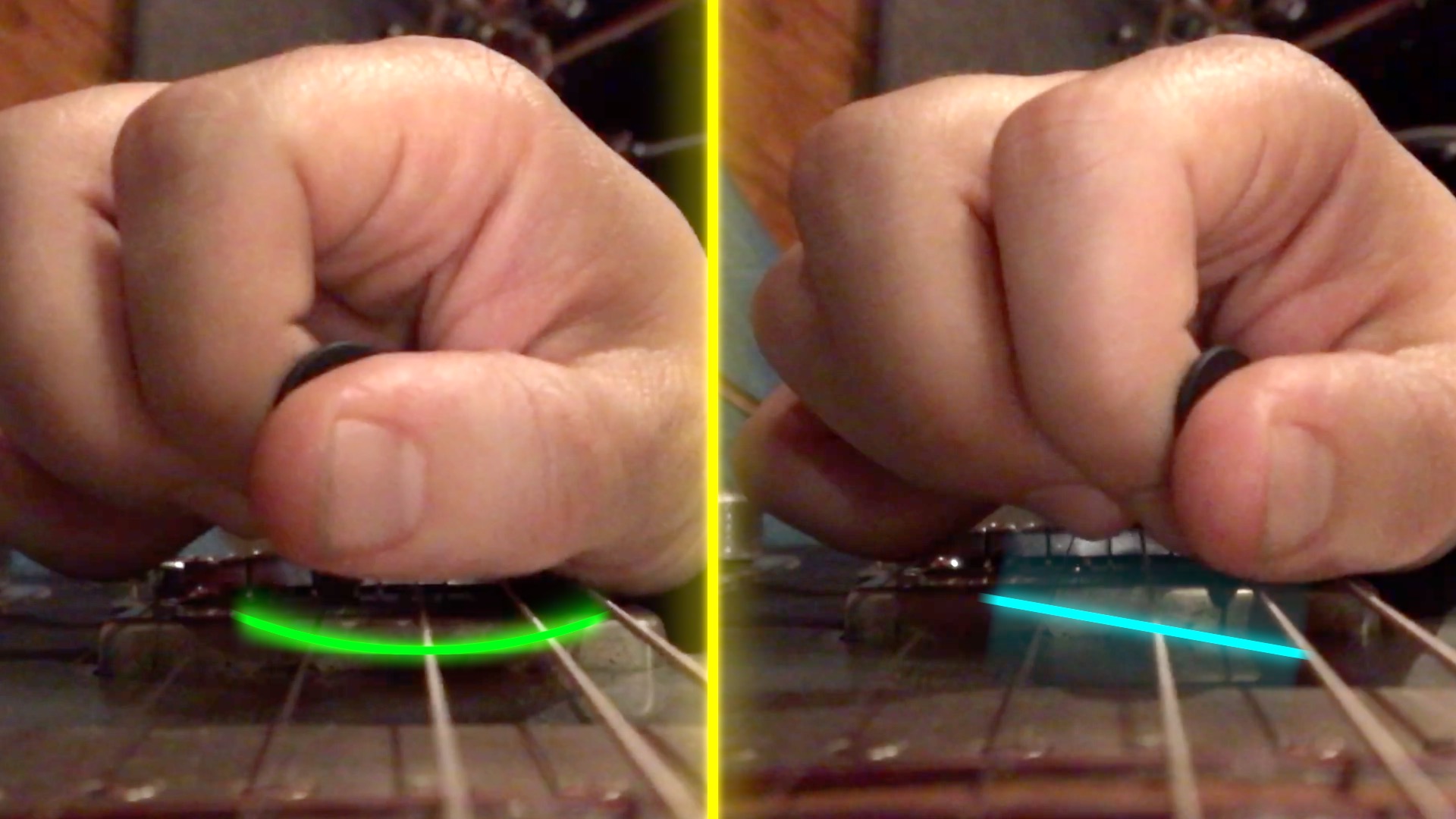
Technically this type of downstroke is a double escape motion, since it both starts and ends in the escape zone above the strings. But unlike the type of double escape motion used in alternate picking, the circular shape of this motion means that only its downstroke phase actually plays a note, avoiding the string entirely on the way back out:

As a result, this type of downstroke can be used to play a single note on a string without hitting the surrounding strings, or to play consecutive notes on a single string with only downstrokes as in metal rhythm playing. George makes use of both capabilities in this phrase, starting with one-note-per-string arpeggio playing and finishing with consecutive downstrokes on the low E string.

The price for this is efficiency, since the upstroke phase of the motion is not being used to play notes as it would be in alternate picking. While George can still do this across a range of useful tempos, it is likely not mechanically possible at his fastest playing speeds, where he avoids this motion in favor of pure alternate or downstroke sweeping.

If the circular downstroke negates the efficiency that makes DWPS economy attractive in the first place, why do players use it at all? The choice likely flows from the arm orientation and downward pickslant often used by DWPS economy players, which make continuous DSX alternate picking impossible without encountering the garage spikes problem. Without a continuous DSX option for playing downstroke escapes, and without forcing the player to alter larger aspects of their form, the simplest mechanical option for playing an escaped downstroke is the circular downstroke. In this regard it could be seen as a kind of secondary or “helper” motion alongside the primary motion of USX alternate picking.

Considering the increased range of fretboard patterns it allows players to execute with picking, and the broad tempo range over which it is mechanically possible, the efficiency penalty of the circular downstroke seems a reasonable compromise. The widespread use of this technique is a de facto confirmation of its usefulness, appearing in the techniques of DWPS economy players in a wide range of styles, like metal master Joe Stump:

Arpeggio Six-Note Pattern Medium Fast

Video access level: Masters in Mechanics

In this repeating pattern, Joe actually uses the motion to connect a downstroke sweep with a successive downstroke on the same string:

In this interesting application, Joe turns the tail end of the sweep into a circular downstroke, avoiding the string on the upstroke. This lets him start the pattern over again on the E string with a downstroke, preserving the picking sequence so that each repetition of the phrase is mechanically the same.

Gypsy Picking

The use of consecutive downstrokes in the DWPS economy style is particularly common on acoustic instruments where volume and projection are prized, figuring prominently in the techniques of Greece’s bouzouki and the cuatro of Puerto Rico. Perhaps the most well known and influential of such approaches in guitar music is the Gypsy picking style of Django Reinhardt.

In this rare footage of Django recorded with synchronized sound, Django plays a diminished line with a structure very similar to the one we looked at on George Benson’s instructional video:

Django Reinhardt Jazz Hot Diminished

Video access level: Masters in Mechanics

The E and A strings of the phrase are pure alternate, using USX and switching on upstrokes. From there, Django uses stacked instances of DDU to simplify the complexity of the upper string changes. He plays the first triad on the D and G string pair, and the second on the B and E string pair, before finishing with a position shift and single downstroke:

Django Reinhardt Jazz Hot Diminished Pickstrokes

Video access level: Masters in Mechanics

We know from our interview with historian Ben Givan that Django’s signature style emerged soon after his hospital stay from the caravan fire that burned his fretting hand. It’s tempting to speculate that a picking style based on downstrokes and downstroke sweeping that uses Django’s flexed wrist position might have developed while recovering in bed with a picking arm draped over the body of an acoustic guitar. So it is fitting that some of the only known footage of Django’s live playing features him cradling a guitar while reclining on a couch, a playing posture that is not particularly common among guitarists of other picked styles.

Although it seems likely that Django discovered his mechanics on his own, it’s worth noting that popular players of the period like Eddie Lang and Nick Lucas also appeared to use the DWPS economy style. Both players had already found stardom in music and film by the 1920s, before Django developed his mature technique, and would likely have been known to him. Eddie Lang died young, so better footage exists of Nick’s technique, like this television performance on the Lawrence Welk show:

Nick Lucas Rose Colored Glasses

Video access level: Masters in Mechanics

It appears that Nick used almost exclusively downstrokes, for both single note lines and swept phrases, but the blazing arpeggios at the end of the solo are no less impressive for it. It’s not clear what opportunities Django would have had to physically observe the techniques of even very popular players like Nick, but the similarities between his form and Nick’s are obvious, from the supinated arm position, to the wrist flex and downward pickslant. But it’s just as likely that all these approaches flowed from a common popular musical style that emphasized bass-chord downstroke rhythms with downstroke arpeggiation, and Django simply elaborated that style more specifically for lead playing.

Thanks to the efforts of the Gypsy community to systematically teach Django’s mechanics, modern Gypsy virtuosos like Joscho Stephan are remarkably consistent in the application of what we have come to know as “Gypsy Picking”. At its core is USX motion applied to even-numbered note groupings for rapid alternate picking, like this fluid two-note-per-string example from Gypsy virtuoso Joscho Stephan:

2nps Asc-Desc

Video access level: Masters in Mechanics

And just as in Yngwie and George Benson’s techniques, downstroke sweeping is applied in sonically stealthy fashion even for scalar playing, such as this three-note-per-string example:

Nuages Scalar Sweeping

Video access level: Masters in Mechanics

Finally, consecutive downstrokes, employing the circular downstroke motion, are used for descending lines whenever USX escaped upstrokes aren’t possible:

Exercise Down-Up-Down Desc

Video access level: Masters in Mechanics

In this very common Gypsy application of consecutive downstrokes, the third note on each string uses the circular downstroke motion, so that its upstroke phase avoids the string and doesn’t play a note:

As we can see in slow motion, an alternate picking upstroke is still performed, it’s just not used. In bypassing the string on the way back, picking speed is effectively cut in half. If great Gypsy players like Joscho are able to perform this motion quickly, it’s only because their actual alternate picking speed is very fast to begin with, essentially double the speed of their fastest consecutive downstroke playing.

Thumb Picking

As one explanation for the ubiquity of the DWPS economy system, we can look to what is perhaps the simplest picking technique of all time: thumb technique. When used without a plectrum, the alternate picking motion of the thumb is USX, closely mirroring the Gypsy technique of downstroke rest strokes and escaped upstrokes. Downstroke sweeping is similarly possible by continuing thumb rest strokes through the next string.

The most well-known thumb player in popular guitar is jazz legend Wes Montgomery. His celebrated technique produced remarkably sophisticated fretboard excursions that belied the seeming simplicity of the underlying mechanics:

Wes Montgomery Impressions

Video access level: Masters in Mechanics

Upon closer inspection we shouldn’t be too surprised by Wes’ agile soloing, since his thumb technique possesses most of the advantages of pick-based DWPS economy playing. In this overhead closeup of his right hand, the intricate interplay of alternate, sweep, and consecutive downstroke techniques is plainly evident:

Wes Montgomery Four On Six Overhead

Video access level: Masters in Mechanics

The first statement of this brief excerpt is an excellent demonstration of the similarities between thumb and pick DWPS economy execution:

This textbook example of downstroke economy uses sweeping to connect a single note on the A string to three alternate picked notes on the D string and an another single note on the G string. This is essentially two stacked instances of DDU across adjacent pairs of strings, so it’s broadly similar to how a Gypsy player or even Yngwie Malmsteen might handle a similar fretboard arrangement.

In total, Wes’ technique relied more heavily on consecutive downstrokes than Gypsy technique or even George Benson’s approach, though less than the technique of Nick Lucas, who appeared to be almost entirely reliant on downstrokes and downstroke sweeping. The commonality of all these approaches, whether implemented with a pick or a finger, speaks to the universality, simplicity, and overall “guitaristic” nature of the DWPS economy system.

Double Escape Picking

By

In the double escape syle, DBX motion is used as the starting point for most phrases, often with subtle modifications at higher speed, or for phrases were two escapes are not necessary.

A great example of player whose technique fits this style is Molly Tuttle, who maintains her primary double escape wrist motion across a wide range of phrases, like this blazing five-string fill:

Freightliner Houston Fill

Video access level: Masters in Mechanics

The phrase ends with a four-string sequence where every string change is an upstroke, which could technically be played with a USX technique. But in slow motion it’s clear that Molly executes the entire phrase with DBX:

Freightliner Houston Fill

Video access level: Masters in Mechanics

As we saw when we looked at primary motion, the subconscious tendency to standardize on a specific picking motion even when others might also work is probably one of economy, reducing the amount of time and effort it takes to master and memorize complicated motor skills like picking technique.

When it comes to phrases that require alternate picking only one note on a string, there’s no choice to make, since a curved picking motion is the only way to play a single note and escape again. One such phrase, the ragtime-inspired arpeggio section from the bluegrass standard “Beaumont Rag”, has become a benchmark of double escape proficiency:

Beaumont Roll

Video access level: Masters in Mechanics

In this pattern, known generically as a forward roll, a three-note arpeggio is played ascending across three strings with one note on each of them. Because the pattern has an odd number of notes — three — each successive iteration starts on a different pickstroke. This generates repeated string skips with both inside and outside picking:

Beaumont Roll

Video access level: Masters in Mechanics

Motion Variation

Even though primary DBX players like Molly may use a broadly similar motion much of the time, they still make changes to that motion based on the phrase they’re playing, and these changes can be surprisingly complex.

A really interesting example of this is the double escape technique of Olli Soikkeli, whose motion is based on a blend of wrist and forearm joint action:

II-V-I A Position Melody

Video access level: Masters in Mechanics

Slowed down, the curvature of Olli’s picking motion in this moderate-speed swing line is consistent across the length of the phrase:

II-V-I A Position Melody

Video access level: Masters in Mechanics

What’s surprising about this is that Olli actually built his technique playing Gypsy jazz, which is a style essentially designed for USX motion. In fact, Gypsy swing is among the most standardized picking techniques in guitar, where Django’s particular flexed-wrist form and blend of forearm and wrist motion are taught systematically to new players.

As a result, Gypsy vocabulary features an array of standard phrases arranged to make upstroke escape possible. Diminished arpeggios are a great example of this type of fretboard organization:

Arpeggio Diminished Slow Tk2

Video access level: Masters in Mechanics

When fretted two notes per string and played starting on a downstroke, each string ends with an upstroke, making diminished arpeggios a perfect candidate for Gypsy-style USX technique. But when Olli plays them, his motion doesn’t look like USX:

Arpeggio Diminished Slow Tk2

Video access level: Masters in Mechanics

In Gypsy-style USX motion, upstrokes escape with help from the forearm joint, and downstrokes trap, frequently rest stroking against the next higher string in the process. But when Olli plays this phrase, the downstrokes don’t trap or rest. Instead, the downstroke starts out high above the strings for a loud attack, but immediately upon striking the string it reverses trajectory, escaping above the plane of the strings a small amount as the motion finishes:

This “J”-shaped pickstroke is still a double escape motion, just an asymmetrical one. In the short loop above, the size of the motion on the right side of the string is longer than the path of the motion on the left side of the string.

This observation is really interesting because in our interview Olli explains that he uses Gypsy technique for phrases like this one to deliver the downstroke attack called for in that musical style. But upon viewing the footage, it became clear that he wasn’t actually using Gypsy technique at all. Instead, when Olli plays “Gypsy”, he simply tweaks his double escape technique so that downstrokes are bigger and louder than upstrokes, but the motion still escapes at both ends. This is another testament to the stickyness of primary motion, where a player may find it subconsciously less work to modify a motion they already know than to learn a completely new one.

Becoming Single Escape

Sometimes this modification of primary double escape motion is taken even further to where it actually becomes single escape motion. There are lots of examples of this in the technique of picking pioneer Steve Morse:

Chromatic Two Strings Upstroke

Video access level: Masters in Mechanics

This familiar one-finger-per-fret coordination exercise is a classic single escape phrase because it contains four notes on each string. Depending on the pickstroke you start with, it can be played with either USX or DSX motion. In this example Steve is starting on an upstroke, so the final note on each string is a downstroke, requiring DSX motion. And when viewed up close, that’s almost what Steve’s motion looks like:

Chromatic Two Strings Upstroke

Video access level: Masters in Mechanics

Steve has modified the symmetry of his technique similar to the way Olli did, except in reverse. In Steve’s modification, downstrokes are now the escape strokes, and upstrokes now trap, effectively becoming DSX motion:

What’s interesting about this is that Steve’s pickstroke still curves upward upon hitting the string, just as we would expect of a double escape motion. But it just doesn’t go far enough to actually escape. In fact, if you watch the full phrase in slow motion, you can see that Steve occasionally executes a rest stroke on upstrokes, where the pick cannot phsyically escape because the string is in the way.

The appearance of this is really quite unique. Common DSX mechanics like elbow motion and even other wrist motions like Andy Wood’s DSX technique appear to move in a straight line when viewed down the strings. But when double escape players like Steve modify their motion to be single escape, it often retains aspects of its double escape shape.

In essence, when confronted with phrases that don’t actually require both escapes, players like Steve and Olli are subconsciously converging on the same solution to simplify their techniques: single escape motion.

Mixing Escapes

Molly Tuttle also switches occasionally to single escape for specific phrases like this chromatic fill:

Freightliner Fill Tk1

Video access level: Masters in Mechanics

The first three notes of this phrase occur on the low E string, starting and ending on a downstroke. And in slow motion we can see that Molly plays this with DSX motion, where only the downstrokes actually rise above the E string and escape:

Freightliner Fill Tk1

Video access level: Masters in Mechanics

Just as with Steve’s approach, the three notes on the E string still bear some curvature, as the portion of the pickstroke to the right of the string in this landscape example appears flatter than the escape portion to the left of the string. Once Molly reaches the A string, she reverts to her U-shaped double escape motion again.

This unique hybrid approach, where the low E string uses DSX and the A string uses DBX looks almost exactly like what Brendon Small does when playing six-note patterns on the two lowest strings:

Sixes Ascending Hybrid Escape

Video access level: Masters in Mechanics

Like many rock players, Brendon’s slower speed primary motion is actually DBX, transitioning smoothly to DSX as he speeds up. In this example he’s got one foot in both techniques as he executes the E string notes with DSX and the A string notes with DBX.

Steve Morse offers an especially sophisticated example of mixing escape types in his scale playing, where his motion can appear to be double, upstroke, or downstroke escape at different points in the phrase:

Scale Fourth Finger Downstroke

Video access level: Masters in Mechanics

As Steve navigates the mixed two- and three-note-per-string fingerings of this scale sequence, the occasional upstroke rest strokes are the clue that something about the motion is changing from string to string:

Scale Fourth Finger Downstroke

Video access level: Masters in Mechanics

Close up, the B string offers an interesting example of the adjustments Steve is making. The first note starts out with the downstroke escaped, the second note looks trapped but with Steve’s usual curvature, and the third note escapes on the upstroke, so he can switch strings. Here’s the entire sequence:

Steve’s not playing at shred-level speeds here, but what he’s doing is still pretty fast for the complexity of the line that he’s picking, and the kind of fine adjustments he’s making while he does this. This type of fine motor adjustment at a relatively high rate of speed would have to be memorized to be done with any kind of accuracy, and this would take time and practice.

DBX And Learning

On paper, an appeal of double escape playing is that it would seem like less work to learn since it is one motion that can switch strings in any direction. But as these examples show us, it’s not always one motion in actual use.

Instead, using double escape as a primary motion really appears to be a starting point for lots of subconscious tailoring on a phrase-by-phrase basis. At slower speeds, players like Molly, Olli, and Steve make consistently double escaped motions throughout entire phrases. But as tempos increase, or when confronted with fingerings that could be done with single escape motions, these players tweak the primary motion accordingly.

Why do they do this? We’re not sure, but we can only assume that there is some benefit in terms of efficiency, simplicity, or accuracy. Either way, what this tells us is that developing double escape technique doesn’t necessarily offer a learning short cut compared to an approach that requires mixing and matching other motions, since mixing and matching is precisely where many of these great players appear to end up eventually. They’re just doing it from a double escape starting point.

Figuring out and memorizing slightly different joint motions for different phrases in your vocabularly can only occur with lots of playing time. And this is really no different from the amount of work that players of any other technique have to do to build out a wide-ranging vocabulary.

DBX And Improvisation

Another appeal of primary double escape as a picking style is that it would seem to be ideal for improvisation. If the motion can execute both upstroke and downstroke string changes, then in theory the technique has fewer restrictions or “rules” than a style like single escape picking, which requires a certain number of notes per string that won’t fit with every phrase.

But viewing great improvisers like Steve Morse in slow motion makes the case that double escape playing is in fact just as structured and memorized as any other picking style. Playing guitar with a pick requires executing complex sequences of motions at high speed with high accuracy. And such tasks are generally memorized at the level of the motions themselves. And somewhat ironically in the case of double escape players, those motions are very often reduced to simpler strategies like single escape when possible.

Ultimately, building out wide-ranging improvisational vocabulary entails a certain amount of mechanical memorization, and double escape players are as bound to this as players of any other style. Their choices are also apt to be just as arbitrary, where even world-class pure alternate pickers rarely seem to play lines like Eric Johnson’s famous pattern of fives, even though this pattern is very common among economy players in lots of different musical styles.

Whatever the reason, it is clear that picking technique exerts a strong subconscious influence on the lines you choose to play. The net effect is that double escape players don’t necessarily have bigger or more creative vocabularies than players with other picking techniques, just different vocabularies.

Primary Plus Secondary Motion

By

A common strategy for combining motions is to use utilize a secondary “helper” motion to handle string changes the primary motion doesn’t do.

With so many picking motions available to choose from, how many should you use, and how would you combine them? A common solution to this problem is to take a single-escape picking motion and augment its capabilities with an additional motion that you only use once in a while. This type of “primary plus helper” strategy offers the simplicity of single escape picking with a little extra flexibility for picking a wider range of patterns.

Primary DSX Plus Secondary

For example, here’s the amazing Andy Wood playing an ascending scale using an approach that combines his DSX wrist primary motion with an secondary assist from forearm rotation:

Mixolydian Scale Ascending

Video access level: Masters in Mechanics

One of the unique characteristics of three-note-per-string fingerings is that when played with alternate picking, the sequence of pickstrokes on each string will be the inverse of the one before it. If the first string of the scale is played DUD, then the next string will be UDU, the next one DUD, and so on.

Since Andy’s primary motion is DSX, all the “DUD” strings will end on a downstroke, and the pick can simply move to the next string using the escape stroke. But what about the “UDU” strings, how does he manage those string changes? For the answer, we’ll need to take a closer look in slow motion:

Mixolydian Scale Ascending

Video access level: Masters in Mechanics

Andy starts the first string of the phrase with his primary motion, wrist DSX, so the last note on the string is a downstroke, which escapes. As it does, the diagonal motion of the pick is really easy to see here, moving into the air above the D string for the string change.

Once he begins picking on the D string, Andy maintains his primary motion for the initial upstroke as well as the second note, the downstroke. But on the third and final note, the upstroke, he introduces an additional motion to assist in creating the escape — forearm joint motion:

It’s easy to recognize when Andy engages the forearm joint because motion of the forearm creates a curve, causing the pick to rotate in space. Wrist joint motion doesn’t do this, which is how we know a different joint is actually being used here.

The purpose of the rotation, of course, is to get over the string, like a somersault in gymnastics. As soon Andy clears the D string, he begins rotating the forearm the other way, so that by the time he finishes playing the downstroke on the new string, the forearm is back to its starting orientation and the helper motion is complete.

This clever solution turns three-note-per-string scale playing into a simple repeating two-string sequence, where the first five notes are performed with the primary motion and the last note is performed with the secondary. Simply connecting these two-string sequences together, as Andy does in the rest of this phrase, makes it possible to play scales of any length, up to and including all six strings.

Simple Primaries

Andy’s primary motion mechanic is the wrist, and as we’ve learned, the wrist can perform a wide range of DSX and USX motions. So Andy’s choice to standardize on DSX motion is simply for economical reasons, to cut down on the number of motions he has to learn and memorize.

But other common joint choices for DSX motion, like the elbow joint, don’t have multiple axes of operation. For players who choose these simpler joints as a primary motion mechanic, secondary motions are necessary to make upstroke string changes possible. A classic example of this is the high-speed technique of shred pioneer Vinnie Moore, who augments his elbow primary with forearm secondary in a strategy similar to what Andy does:

Vinnie Moore Pepsi Lick

Video access level: Masters in Mechanics

Vinnie famously played this six-note pattern in a 1985 Pepsi commercial to such acclaim that we now simply refer to it as “The Pepsi Lick”. Although Vinnie was only on-screen for hand closeups in the commercial shoot, we did eventually get to see the actual picking motions involved on his second instructional Video, “Speed, Accuracy, and Articulation”, from which this clip was taken.

Vinnie’s strategy for this is similar to Andy’s, using his primary DSX elbow motion for five notes of the scale, and a dash of forearm rotation for the sixth note to get back over the string. The only twist here is that that he’s playing the sequence descending, starting on a downstroke, but otherwise the mechanics are very similar: the first string change is automatic thanks to the escape of the primary motion, and the second string change is where the secondary motion kicks in.

Michael Angelo Batio actually plays the same lick in the ascending direction also using a primary and secondary motion strategy:

Sixes Asc Upstroke

Video access level: Masters in Mechanics

Because Mike starts the pattern on an upstroke, the helper motion kicks in on the third note of the scale, to allow him to get to the higher string. Then the primary motion is engaged to return to the lower string with no rotation. When you look at the motions being used on each string of the pattern, this is the exact same sequence as in Vinnie’s version of the pattern. So interestingly, even though the direction of the phrase is flipped, if you turned off the sound and only looked at the picking hand, you wouldn’t be able to tell which version of the phrase Mike was playing.

Like Vinnie, Mike is an example of a player whose primary motion appears to be DSX-only. In fact, it’s always been something a minor mystery precisely which primary motion mechanic Mike actually uses. The escape is very shallow, which is consistent with elbow motion, but it could also be a mix of wrist flexion-extension as well. We really don’t know! But it was actually Mike’s 1991 instructional classic “Speed Kills” that provided the first clue to how secondary motion works:

Mike’s strategy for ascending scale playing is the same as Andy’s, with five primary motion pickstrokes followed by a sixth with the secondary. Noticing the small shift in Mike’s hand position as he engages the secondary was the breakthrough in understanding how he navigates the strings with such accuracy.

Primary USX Plus Secondary

Primary-secondary strategies work with USX motion too. Here’s metal master Teemu Mäntysaari adapting the classic descending fours sequence to his primary USX wrist motion:

Teemu Dragon Lead1

Video access level: Masters in Mechanics

In the descending fours pattern, a four-note diatonic sequence is iterated across the strings, shifting one note lower each time. Just as with Andy’s scalar approach, Teemu starts with his primary motion, except this time it’s USX. But when he reaches the third note, he engages the forearm and also a bit of wrist extension to lift that pickstroke almost straight up in the air:

As soon as he does this, he begins rotating the forearm back to its original position, allowing him to pick the single note on the B string with an escaped upstroke, and transition back to the top string for another downstroke. So that’s two string changes in a row — one with the secondary motion and another with the primary right after that.

One of the interesting things we’re seeing in Teemu’s approach is that his secondary motion isn’t actually a single motion at all but two joints coupled, or operating together. This combination of forearm rotation and wrist extension is extremely common as a secondary motion for wrist players, especially when their primary motion is USX and their arm position is supinated. It’s easy to see here in Teemu’s technique because the pickstroke moves visibly vertically.

Non-rotational Secondary Motion

Given its rotational capability, the forearm is a common choice for secondary motion, but it’s not the only one. The wrist is also a popular choice as a secondary motion, even when the primary mechanic is also wrist motion. For a closeup look at this seemingly counterintuitive occurrence, we can turn to Andy Wood once again:

Andy Wood Primary And Secondary Wrist Motion

Video access level: Masters in Mechanics

In this improvisational excerpt from his all-acoustic interview, Andy plays a circular scale sequence on the top string that includes both downstroke and upstroke string changes. The first string change is a downstroke, from the B string to the E string, and it’s done with Andy’s primary DSX wrist motion, whose diagonal escape path is easy to see in slow motion:

Andy Wood Primary And Secondary Wrist Motion

Video access level: Masters in Mechanics

The way back to the B string is an upstroke, and it’s also handled by the wrist — but with USX motion instead of DSX. Notice how the pickstroke changes direction to lift over the B string:

The question isn’t really whether or not Andy’s forearm adjusts as he does this. It might, a tiny amount. But that motion is too small to cause the lifting we’re seeing here. Unlike the ascending scale example we looked at, where the rotation of the forearm was the motion that lifted the pick and caused it to escape, in this example it’s the wrist joint doing the lifting, and changing its direction of motion to do so.

Primary And Secondary Wrist Motion

At first glance it may seem arbitrary to call one of these motions “primary” and the other “secondary”, since they’re just two slightly different motions generated by the same joint. But this makes more sense when you realize that there is never any continuous USX picking in Andy’s technique. USX motion, when it occurs, is used only for specific string changes like the one in this example, after which he returns immediately to DSX motion.

In fact, in the looped example above, notice that Andy could have switched to USX motion for all the notes on the E string, but he chooses DSX instead. It is the choice to use DSX by default that makes this “2 o’clock” wrist motion the primary in Andy’s technique, and the occasional USX upstroke the secondary.

Andy also uses USX for upstroke string changes on mandolin. His playing on the bluegrass standard Liberty is a great example of this:

Liberty

Video access level: Masters in Mechanics

As usual, the primary motion in this example is DSX wrist. But unlike the ascending scale example, there are no forearm helper motions here. Instead, all the upstroke string changes in this clip are USX wrist motion:

Liberty

Video access level: Masters in Mechanics

In this case there really doesn’t seem to be any forearm adjustment at all. The pick escapes on the downstroke with wrist motion, and also on the upstroke with wrist motion, just moving in a different direction. Back to back, this basically creates DBX or double escape motion:

You might wonder how Andy is able to do this without altering the pickslant to correct for the attack. The answer is that DBX motion works fine with with a zero-degree pickslant. Instead, the trickier question is why Andy doesn’t need to change his pickslant to UWPS when he switches back to continuous picking with only DSX motion.

And the answer to that is edge picking. As we saw when we looked at upward pickslanting, many DSX motions are shallow enough in their escape that when you throw in a little edge picking, the motion will still be smooth without any significant UWPS. So in Andy’s mandolin technique, where the escape is shallow most of the time, Andy can switch between DSX and USX while maintaning constant pick orientation.

Secondary Motion vs Two-Way Pickslanting

When we saw Andy’s ability to switch between different picking motions with no change in pickslant, it was a turning point in our understanding of how these techniques actually work. In earlier versions of the Pickslanting Primer, we called secondary forearm motion “two-way pickslanting” because of the way it appears to change the orientation of the pick. But this was misleading, because this is not the only way to play a scale. Andy can achieve the same result with only wrist motion as the primary and the secondary and no change in pickslant, and calling that approach “two way pickslanting” doesn’t make much sense.

Instead, what really matters here is the change in motion. Simply “slanting the pick” by itself won’t actually do anything anyway unless you also change the way the way the pick is moving. Whether you do that with wrist motion, forearm motion, or some other joint is really what you need to think about when learning these techniques, not what the pick itself looks like. So for now, we think that terms like “primary motion” and “secondary motion” are a much clearer way to understand how this particular technique works, and how to actually do it.

Single Escape Plus Swiping

By

A simple way of expanding the capabilities of a single escape picking motion is to play through muted strings using swiping.

Single escape picking motions are some of the most common motions in picking technique, used by everyone from John McLaughlin to Yngwie Malmsteen. The distinctive vocabularies of these players are filled with clever ideas, like John’s four-note pattern and Yngwie’s six-note pattern, constructed with even numbers of notes per string. This allows them to capitalize on the efficiency of escape motion for high-speed string changes.

But what if you want to play an odd number of notes on a string? Many common musical phrases, like straight-line scale playing, involve doing precisely that. As it turns out, doing this with single escape motion is possible with a clever hack: swiping.

DSX And Swiping

A great example of the way escape motion and swiping can work together is the alternate picking technique of shred pioneer Michael Angelo Batio. Mike’s core motion is DSX, with downstrokes that escape and upstrokes that trap. In the Antigravity Seminar, we discover that Mike uses strategic swiping on some of those upstrokes to move to a lower string without escape motion:

Sixes Asc Downstroke

Video access level: Masters in Mechanics

Much like Jorge Strunz’s stealthy swiping, listening to this example at normal speed gives no indication that Mike is playing through any muted strings. It’s only when you view this close up that the mystery is revealed:

Sixes Asc Downstroke

Video access level: Masters in Mechanics

The first string change in this repeating six-note pattern is a downstroke, and as you can see in the clip, downstroke string changes are no problem — the pick just sails right over the E string. But the last note of the pattern is an upstroke that returns to the B string, and swipes right through it in the process. Thanks to Mike’s use of left-hand muting we don’t hear the swipe, but in slow motion the string clearly moves as the pick hits it on its way to start the pattern over.

The benefit of this approach is that it takes a phrase which wouldn’t ordinarily be playable with single escape motion and makes it possible. Rather than devising a more complicated solution that combines different motions, the motor system satisfies its need for simplicity by using a single motion for the entire phrase.

The power of this becomes especially obvious across longer phrases where the technique can be used repeatedly. A classic example in Mike’s vocabulary is descending scale playing, which he performs entirely with DSX motion and occasional swiping:

Jazz Pedal - tk2

Video access level: Masters in Mechanics

Just like the repeating six-note scale pattern, this amazing blast of descending scalar speed utilizes swiping to transition from higher strings to lower strings whenever the string change pickstroke is an upstroke.

Specifically, the final phrase of this lick is six full strings of a diatonic scale fingering with three notes on each of them. The first string change, from the E string to the B string, is a downstroke. Downstrokes in DSX motion are escaped, so that string change is no problem — the pick simply drops down on the B string and continues picking. The second string change is an upstroke from the B string to the G string, so that one is handled via swiping. Just as in the scale pattern phrase, no change to the picking motion is necessary, Mike just picks right through it. The third string change is once again a downstroke, handled via escape stroke. The next one is another swiped upstroke. And so on, across all six strings of the instrument.

Three-note-per-string scale playing has long been a hallmark of elite-level picking technique, and Mike in particular is known for his accuracy in doing this. His solution to descending scale playing is ingeniously simple, converting what could be a tricky coordination challenge into a simple application of just one picking motion.

USX And Swiping

Gypsy maestro Joscho Stephan uses swiping to play the exact same repeating six-note phrase Mike does, just with the mechanics reversed, using USX motion:

Chromatic Sixes Asc

Video access level: Masters in Mechanics

Listening to this at normal speed, you’d never guess that Joscho was playing through a muted string. To detect it, we’ll have to drop into a slow motion closeup.

Again, Joscho is using USX motion, where upstrokes escape and downstrokes trap, so this time the swipe pickstroke is going to be a downstroke. That means the third note of the phrase, the downstroke on the B string, is the note to look out for. Right after Joscho plays that note, watch in slow motion as he pushes through the high E string to get to the other side:

Chromatic Sixes Asc

Video access level: Masters in Mechanics

After the swipe, Joscho plays the final three notes on the top string: up, down, up. This leaves him in the escaped zone, perfectly positioned to drop right back down again and start the pattern over again.

It’s really pretty remarkable how quiet the swiping is in this phrase — there’s very little sound being made by this at all, not enough to be detectable at normal playing speeds.

Directional Swiping

In both Joscho and Mike’s scalar swiping examples, they’re using swiping on the pickstroke that lines up with their pickslant. In other words, Joscho is using a downward pickslant, so he swipes on the downstroke that moves toward the higher string. Mike uses a very slight upward pickslant, but UWPS nevertheless. So Mike’s swipe pickstroke is the upstroke that moves toward a lower string, the same way the pickslant points.

Lining the swipe up with the pickslant makes use of the same mechanics we saw when we looked at sweeping, where the reduced angle of attack promotes sliding. The pick is essentially making a trapped motion, moving in a straight line through the strings, but because of its slant, it has less tendency to forcefully grip the next string and pluck it. The difference between swiping and sweeping is that we’re just muting the second string so we don’t hear it.

Their use of single escape motions with pickslanting is why Mike only swipes when descending and Joscho only when ascending. We’ve seen Jorge Strunz use swiping in both directions, but recall that Jorge uses a trapped motion with a zero-degree pickslant and a high degree of edge picking. So Jorge’s mechanics are essentially symmetrical, allowing equal amounts of sliding in both directions. It’s worth pointing out that when Jorge swipes, we can still see the strings being plucked in slow motion:

Tens Eights Sixes Circular Closeup

Video access level: Masters in Mechanics

So the symmetry of Jorge’s pick attack and motion are not enough by themselves to make the swipe quiet, but instead work together with Jorge’s effective use of fretting-hand muting to really deaden the noise.

Single Escape Picking

By

In a single escape picking style, you use either USX or DSX motion exclusively, and structure phrases so that string changes occur only during the escape pickstroke.

Single escape motions like USX and DSX are diagonal picking motions where only one of the pickstrokes — either the upstroke or the downstroke — is an escape pickstroke. In other words, only every other pickstroke can switch strings. So in the most straightforward form of a single escape phrase, string changes only occur during that pickstroke.

For example, here’s Oz Noy playing an ascending scale using an interesting four-note-per-string fingering on every string:

Scale Major 4nps Downstroke Escape Ascending

Video access level: Masters in Mechanics

On the surface this seems unremarkable enough. It’s only when we slow down and look closely at what’s going on in the picking hand that the uniqueness of Oz’s single escape approach becomes apparent:

Scale Major 4nps Downstroke Escape Ascending

Video access level: Masters in Mechanics

Oz is using a downstroke escape, or DSX motion. This is a diagonal picking motion where downstrokes go up in the air, and thus have string switching capability. When you use a DSX motion, you can only move to a new string when you play a downstroke.

So this motion is a perfect match for this phrase, because that’s exactly how its string changes work. Each string contains four notes, starting on an upstroke and ending on a downstroke. Thanks to its diagonal escape trajectory, the final downstroke clears the next string, and Oz can begin the pattern again one string higher.

The Rule of Evens

The synergy between the motion Oz is using and the phrase he’s playing makes good mechanical sense. Alternate picking is a system of twos — down and up. In a DSX motion like Oz’s, the string-switching pickstrokes are downstrokes, and they only occur every second note. So it follows that when you use a single escape motion, and you’re picking every note, you’re going to have to pick an even number of notes on every string.

And it turns out that this is a pretty natural thing to do, because a lot of guitar licks actually work this way. Think about the common one-finger-per-fret coordination exercise:

Alternate Picking - Chromatic 4nps Exercise

Video access level: Masters in Mechanics

Like Oz’s clever scale fingering, this exercise also has four notes on every string. So if you start on a downstroke, the final note on every string will be an upstroke. To play this with single escape motion, you’re going to need to use an upstroke escape, or USX motion, because that’s the motion type where upstrokes go up in the air. And this is exactly the type of motion that Gypsy maestro Joscho Stephan uses for playing the same phrase:

Chromatic Desc

Video access level: Masters in Mechanics

The Gypsy picking style is based around USX alternate picking motion, specifically using a distinctive blend of forearm and wrist joint action, and an immediately recognizable flexed wrist posture. So phrases like this one, with four notes per string, starting on downstrokes, are a perfect fit for this type of picking motion, and very common in Gypsy vocabulary.

Single Escape Vocabulary

The way Gypsy vocabulary emphasizes even-numbered phrases during alternate picking isn’t an accident, but a very common occurrence across different musical styles whenever single escape picking techniques are used.

One of the most striking examples of a player who chooses phrases for single escape motion is fusion pioneer John McLaughlin. John’s primary motion mechanic is DSX wrist, using the same arm position, and performed with the same “2 o’clock” motion we saw when we looked at Andy Wood. Here’s a great shot of John’s motion from a 1976 performance with the group Shakti:

In this fortuitous down-the-strings camera angle, it’s super easy to see the way John’s DSX alternate picking motion follows a diagonal path with respect to the guitar, shooting way up into the air above the E string. He’s also holding the pick with an upward pickslant, to correct the pick attack, which is what we’d expect when this type of escape path is used.

John’s use of downstroke escape motion is why many of his signature phrases are arranged so that downstrokes are the final note on each string. A classic McLaughlin pattern is this one, which is four notes long:

John McLaughlin Four-Note Pattern Ascending

Video access level: Masters in Mechanics

If you’ve ever transcribed any McLaughlin solos, you’ve no doubt encountered this pattern many times. Although it’s not obvious here from this camera angle, when we film down the strings in slow motion, the single escape construction of this phrase becomes evident:

Four-Note Pattern Asc

Video access level: Masters in Mechanics

Just like Oz’s scale, every string of this pattern contains four notes, starting on an upstroke, and ending on a downstroke. Because of its escape trajectory, that final downstroke moves over the top of the next higher string, allowing us to transition with no mechanical penalty.

A large percentage of John’s fastest playing is organized just like his four-note pattern, with even numbers of notes per string terminating with downstrokes, to match up with his DSX alternate picking motion. This includes not just specific pattern-based phrases like the four-note lick, but also more melodic soloing where the even-numbered construction is less obvious.

A fantastic example of this is John’s blazing take on the Ray Noble classic “Cherokee” with the Tonight Show band in 1986:

John McLaughlin Cherokee Tonight Show

Video access level: Masters in Mechanics

Watching John’s performance, it’s hard to imagine that the lines he’s playing might have been engineered down to the level of assigning specific pickstrokes to specific string changes. But indeed that is the case. Examining the transcription of even a short section of his solo reveals the hidden support structure of John’s ingenious, downstroke-powered string changes:

In this two-bar section, nearly every single high-speed string change occurs when the final note on the string is a downstroke. And that’s not unusual. In the first 33 measures of the solo — the entire verse, before the bridge kicks in — there are 49 string changes that occur during fast single-note playing. Only 4 of them are upstroke string changes. The remaining 45, representing a staggering 92% of the fast string changes, are downstroke escapes.

Subconscious Motor Learning

To be clear, the process through which great players like John organize their vocabularies to fit particular picking motions is largely subconscious. We know this because the players we’ve interviewed are mostly unaware of the motions they are making, even when those motions are pointed out to them.

For example, Andy Wood’s DSX motion is very similar to John’s even down to the specific type of wrist motion he uses. For this reason, Andy typically chooses to start pentatonic phrases on an upstroke, ensuring that the final note on each string is a downstroke, to capitalize on the escape:

Pentatonic Upstroke Tk1

Video access level: Masters in Mechanics

In one fun moment in our Electric Workshop interview, Andy tried playing these basic sequences starting on different pickstrokes. It wasn’t apparent until reviewing the slow motion video later on that the faster takes were always upstroke, even when we thought during the interview that they were downstrokes.

So the tendency toward primary motion appears to be wired deeply, below the level of conscious awareness. This is not a negative — it’s a big win. This allows players to make sophisticated choices like John’s and Andy’s without nerding out on individual pickstrokes, and instead paying attention to bigger-picture physical feedback. Phrases that feel and sound smooth are kept, while those that sound sloppy and feel awkward are avoided. Over time, vocabulary evolves to contain only phrases that can be played with a certain degree of physical ease and reliability.

At the time of John’s Tonight Show performance, the fact that he was using an escaped picking motion was simply not common knowledge, if it was known at all. The link between this motion and the mechanics of switching strings was probably lesser known still. The idea that one of the most purely capable picking technicians of all time might be subconsciously tailoring his vocabulary to the capabilities of his picking motion would have sounded a little crazy, if not maybe even outright insulting to some of his fans. But to be clear, John’s ability to do this isn’t a detriment, it’s an enabler. More importantly, this iterative process where motor skill interacts with musical vocabulary appears to be the way all complex picking technique is learned, regardless of the specific picking motions or vocabularly involved.

Single Escape Speed

Multi-axis joints like the wrist can theoretically make lots of different motions, but as John and Andy demonstrate, the wrist is still perfectly suitable for single escape playing when you rely on just one of its axes for an entire phrase. The result of this single-axis operation is that single escape motions are the mechanically simplest picking motions you can make. In fact, joints like the elbow only have one axis of motion, so when you’re using that joint exclusively, single escape motion is pretty much what you get.

Because of this mechanical simplicity, single escape motions are easy to do fast. Many of the commonly played “fast” licks in different musical styles are single-escape phrases that feature a simplified structure with even numbers of notes per string. In rock and metal, one of the most common is this six-note pattern:

Single String - Six-Note Pattern

Video access level: Masters in Mechanics

Made famous by Yngwie Malmsteen, this simple, repeating phrase consists of six notes and always starts on a downstroke. This initial downstroke is easy to anticipate by feel, and many players, including Paul Gilbert, have spoken about using this pattern specifically as a way to develop high-speed hand synchronization through chunking.

In this case, we’re using a combination of wrist and forearm motion similar to what Teemu Mäntysaari uses as his primary motion:

Scale Six-Note Pattern Single String

Video access level: Masters in Mechanics

Teemu is playing the pattern on a single string, but because this is a USX motion, upstrokes are still escaping. Even though he’s not switching strings, this isn’t redundant or mechanically costly. It’s just a wrist motion, and switching to any other wrist motion wouldn’t make it any more or less mechanically efficient — it would just make it less suitable for moving from one string to another. By using the escaped version as his primary motion, Teemu gains the advantage of not having to change the motion when moving the pattern across the strings:

Scale Six-Note Pattern Medley - tk1

Video access level: Masters in Mechanics

Each six-note unit of the pattern is a self-contained chunk, starting on a downstroke and ending on an upstroke. Because of the final upstroke, Teemu can play this pattern on any sequence of strings, in any direction, either ascending or descending. The direction of the phrase doesn’t matter. As long as the final note is an upstroke, he can move to a higher or lower string smoothly.

Picking Style

By

A picking style is a strategy for choosing which motions to use and when to use them.

At its simplest, your picking technique consists of the motions you know, and your approach for combining them to play different kinds of phrases. But with so many possible motion combinations available, how would you know which ones to use?

The good news is that there are a handful of basic approaches for choosing and mixing different picking motions, and these simple strategies are consistent across different styles of music, and even different plucked instruments like guitar and mandolin. Let’s take a look at how they work.

Primary Motion

By

A player’s primary motion is the default picking motion they choose for single-note playing at a given speed.

With so many picking motions to choose from, which one do players reach for first? It’s a good question, and the simplest way to learn the answer is to ask someone to play a sequence of notes on a single string.

Here’s a short clip of the awesome Andy Wood, taken from a moment in his first interview when he was picking notes on the G string with the volume knob off while answering an interview question:

One of the many advantages of modern camera technology is that you can capture spontaneous moments like this that wouldn’t have been easily visible — let alone filmable — before. Here, we’re getting a look at the picking motion that an elite player chooses subconsciously when they’re not thinking about playing any phrase in particular.

In other words, what we’re seeing here is Andy’s primary motion, which traces an escape path: Andy’s upstrokes rest against the D string, while his downstrokes point right over the top of the B string. So this is a wrist motion that moves along a diagonal where upstrokes are trapped and downstrokes escape. In other words, this is downstroke escape, or “DSX” motion.

It’s important to point out that the actual wrist joint motion Andy is making here isn’t strictly side to side but slightly diagonal, lower on the thumb side of the motion and higher on the pinky side. We call this a 2 o’clock wrist motion, using a simple clock analogy which you can learn more about in the wrist section of the Primer. The point is that if Andy attempts this motion with different arm positions, the resulting escape trajectory can appear to change. But that’s due to the position of the arm, not the motion of the wrist joint. Whenever Andy is asked to play a line that moves quickly, no matter which arm position he’s using, it is this very specific slightly diagonal “2 o’clock” wrist motion that he chooses.

Why Primary Motion?

Why have a primary motion at all? Why not just learn a bunch of different motions and use them as needed? The reason is complexity. The sheer number of variables presented by playing a guitar with a pick is what motor learning researchers call the “degrees of freedom” problem. Put simply, each joint in your picking arm is connected to the next one, resulting in practically infinite motion possibilities by the time you get down to the fingers that are holding the pick. Those are the degrees of freedom.

To learn a picking motion, your body has to sort through all these different ways of moving to find at least one method that it can reliably perform that gives you the result you want. Then you still have to spend the time it takes to master this complicated fine motor skill. To learn multiple motions, you’d have to repeat this process multiple times, only to arrive at several probably overlapping techniques. So you would still have to sort through those motions to determine when to use each one.

Instead, a much simpler approach is to choose a single motion, perhaps even the first one you discover, that satisfies the basic requirement of smooth, effortless picking, and get really good at that one. If certain phrases turn out sloppy or don’t feel smooth with that motion, your motor system may subconsciously try to tweak that motion in a way that works better — let’s say, by recruiting a helper motion for just that phrase. But this process takes time and effort. So sometimes, the simplest solution is just to avoid those problematic phrases entirely, and stick with ones that sound good with the motion you already have. This is how we think the tendency toward primary motion develops.

Identifying Wrist Motion

By

The wrist joint connects the forearm to the hand and allows 360 degrees of motion.

Perhaps the single most common motion mechanic in picking technique is wrist motion. One of the reasons for its popularity is its 360-degree motion capability, allowing it to create any escape type: USX, DSX, or DBX.

The wrist can function alone or in concert with other joints, like the forearm or the elbow, to create even more variations. Even if pure wrist motion isn’t your primary motion mechanic, there’s a good chance you still use it in some capacity.

Wrist Motion

The most visually distinctive characteristic of wrist motion is that when viewed from audience perspective, only the hand appears to move, while everything above that point, from the watch band area all the way to the shoulder, remains mostly still. Andy Wood’s DSX wrist motion is a great example of this:

It may be tempting to imagine that Andy’s forearm and upper arm are locked in place, but a more accurate description is simply that they aren’t moving. The muscles doing the work are only moving the hand back and forth. Andy’s technique is similar to the techniques of Al Di Meola, John McLaughlin, and Paul Gilbert in this respect, who appear to generate most of their picking motion from the hand and not the arm.

Axes of Operation

When you use wrist motion, the forearm joint doesn’t move during picking, but its position still influences which of the wrist’s 360 possible degrees of motion you choose. The end result in all cases will be that the hand moves while the rest of the arm doesn’t. But that hand motion may be different based on which way the forearm is rotated.

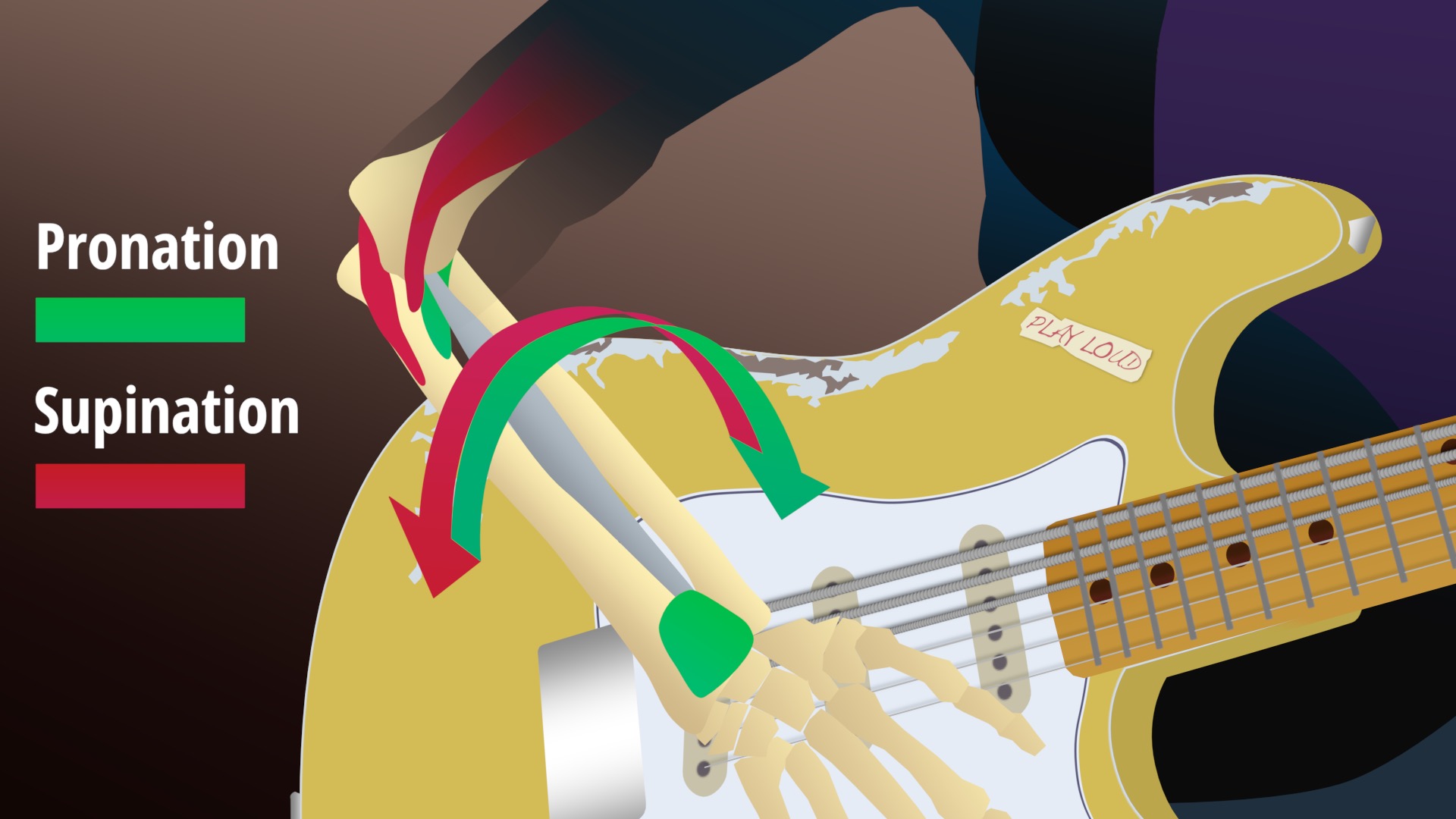
For example, Steve Morse uses what we call a supinated forearm position, resting the pinky side of the arm on the guitar body, and exposing the underside of the forearm to our view:

At the other end of the forearm spectrum we have pronation, where the forearm is rotated in the opposite direction, so that the thumb side of the hand contacts the guitar and the pinky side lifts off the strings. Here’s bluegrass great David Grier’s pronated setup:

David’s pronated form is super obvious here, creating an air gap beneath the pinky. This is the inverse of the way Steve orients his arm.

Now here’s the tricky part. What if we asked both players to make a DSX wrist motion from their respective positions? Here’s what that actually looks like:

Amazingly, they can do it. But look at how different the motion looks. David is essentially making a deviation wrist motion, which is a side-to-side motion of the wrist, from the thumb to the pinky. But because David’s arm is pronated, the deviation motion doesn’t really move side to side any longer, but up in the air. This is how he generates the downstroke escape.

Steve is a totally different story. He can’t use David’s deviation motion because the pinky side of his hand is tilted toward the guitar — he’d hit the body. Instead, he has to use an extension wrist motion. This is the motion that moves the wrist toward the knuckles, like you would when revving a motorcycle. This is a different wrist motion entirely, 90 degrees away from the motion that David is making. And yet, watching from strings perspective, the end result is the same: a diagonal picking motion where downstrokes escape.

So wrist motion isn’t one technique, it’s many techniques in one. The specific direction of wrist motion you choose depends on which way the forearm is oriented, and which way you want the pick to escape given that orientation.

Shallow Escape

No matter which arm position you start with, wrist motions usually generate a shallow escape path between 10 and 15 degrees. For example, unlike the curved path created by USX forearm motion, Mike Stern’s USX wrist motion appears to move almost parallel to the strings in Magnet perspective:

Picking Every Note Improv

Video access level: Masters in Mechanics

Andy Wood’s DSX wrist motion is similarly flat, generating a 10 to 15 degree escape, just on downstrokes instead of upstrokes:

Gilbert Sixes Warp4

Video access level: Masters in Mechanics

Even though Andy’s escape is the inverse of Mike’s, both motions are so close to parallel to the strings that it’s hard to spot the difference without closeup video like this.

Pickslanting

Because of this nearly parallel orientation, you might not always see any pickslanting when you look at wrist players up close. For example, when you look at Andy’s DSX form, it’s hard to determine which way the pick is slanted, if at all:

One of the reasons for this of course is that Andy is using an escape of only ten degrees. So any pickslanting would be slight to begin with. But in addition to that, Andy is using edge picking, which can assist in smoothing out the motion even if he holds the pick perfectly vertically, as he appears to be doing here.

So when the escape is shallow, you can avoid the garage spikes problem with very little pickslanting if you throw in some edge picking. This trick also works in reverse, letting you perform Mike Stern-style ten-degree USX motion with almost no pickslant at all:

Conversely, if you use a more vertical escape angle, and especially if you use very little edge picking, you will need to dial in some pickslanting to correct for the attack. In this respect, David Grier’s form is obvious. Thanks to his pronated forearm, David’s deviation wrist motion escapes at around 30 degrees. And he uses almost no edge picking at all, preferring to play the pick flat against the string. So he requires an equal amount of upward pickslanting, about 30 degrees, to ensure smoothness:

So looking for a pickslant is not a reliable way of knowing what kind of wrist motion a player is making. We saw this with elbow motion, and the same is true again with wrist motion. If you do see pickslanting, that is often a good indicator of escape motion. But if you don’t see pickslanting, that doesn’t really tell you anything, since most wrist players use motions with shallow escape.

DBX Motion

USX and DSX motions like Mike’s, Andy’s, and David’s are single escape, so they move along a diagonal where only one pickstroke escapes. But the wrist can also generate curved DBX motions where both pickstrokes escape, and it can do it with no assistance from other joints.

The amazing Molly Tuttle uses a pronated form similar to what David uses, except this time, she uses the wrist to generate a double escape picking motion:

Whiskey Before Breakfast Warmup

Video access level: Free (Basic Account)

Molly’s motion escapes at each end of the picking motion, but not by much. As with other wrist motions we’ve looked at, the escape is shallow, maybe only 10 or 15 degrees. In a sense, you can think of Molly’s DBX motion as simply the escape part of Andy’s downstroke glued together with the escape part of Mike’s upstroke. Neither of those motions escapes the strings by very much, so even when stitched together to create Molly’s motion, it’s really not obvious that the motion is curved until you slow it down and watch for the escapes.

In general, when you don’t see any motion in the forearm or upper arm, and only motion in the hand, then it’s a good bet you’re looking at some form of wrist motion. If you can recognize the subtle differences in form that we’ve looked at here, then you may be able to guess which escape type you’re seeing, even without close-up video. Of course, knowing what phrase someone is playing also helps. If you hear arpeggio picking patterns like Molly’s, and you don’t see any motion in her forearm, you can be pretty sure that a double escape wrist motion is what’s responsible.

Forearm Mechanics

By

The forearm joint generates a curved picking motion by spinning the forearm on its axis.

Elbow motion moves the entire forearm and hand back and forth, but it’s not the only motion mechanic to do so. The forearm joint also does this, just in a different plane, through a process of rotational motion:

Even though joints like the elbow trace a curved path when they move, we reserve the term “rotation” for forearm motion because it actually causes the arm to spin along its axis.

USX Motion

One of the most famous examples of a purely rotational forearm motion mechanic is Eddie Van Halen’s famous tremolo technique:

Eddie Van Halen Tremolo

Video access level: Masters in Mechanics

In Eddie’s technique, the arm and hand are seemingly fused together, spinning in space as one unit. This is a textbook depiction of forearm joint rotation.

It’s hard to see from this perspective, but Eddie’s forearm rotation is actually a USX motion, where downstrokes move toward the body of the guitar, and upstrokes move away from it, into the escape zone. If we switch the camera angle, this becomes much clearer:

The escape trajectory of Eddie’s forearm motion is super obvious here, with upstrokes pulling way up into the air above the strings. So is the downward pickslant this motion requires:

Eddie’s forearm motion is curved, but it’s not DBX because only the upstroke actually escapes the strings. When it does this, the escape angle is more vertical, making it easy to see. So is the downward pickslant, which is greatest at the top of the upstroke thanks to the fact that the arm is rotating.

This curved motion path, which lifts up and out of the strings in almost vertical fashion, is maintained even when we straighten out the wrist and perform the motion while resting on the bridge. Here’s metal professor Joe Stump’s forearm-driven picking motion:

Technically, there may be a way to orient the forearm so that it produces a motion other than USX. But even if it’s possible, it’s not common. In this respect, the forearm joint is similar to the elbow in that, when it operates on its own, it is mainly capable of only one type of escape motion — in this case, USX.

Forearm-Wrist Motion

Eddie Van Halen’s flying tremolo is a textbook example of the forearm operating independently, but some of the most common forearm mechanics in picking are actually blends that include the forearm and wrist working together.

The most famous of these is the Gypsy picking technique, which utilizes a flexed or bent wrist orientation with a 35-degree downward pickslant. Here’s what Joscho Stephan’s form looks like up close:

Because the wrist flex positions the pick farther away from the point of rotation, Joscho’s technique generates a wide gently curved motion path:

Although this motion path still exhibits the characteristic curvature of USX forearm motion, that curvature is now flatter thanks to the introduction of wrist motion. The overall path is closer to a straight line, just on a tilt:

Specifically, in forearm-wrist blended motion, the forearm joint is responsible for the picking motion from the top of the upstroke until the moment when the pick hits string. That’s why this portion of the motion path is curved. If you look at at the forearm during this part of the motion, you can actually see it turning:

But once the pick hits the string, it’s a different story. The motion flattens out, and the pick simply travels forward until it hits, or rest strokes against the next string. If you look at the forearm while this happens, you’ll notice that it’s no longer moving. So the forearm joint isn’t responsible for this part of the motion path — the wrist is. This cooperation, or coupling between the two joints is seamless, and hard to feel, even when you’re the one doing it.

When you view a motion down the strings, and you can see the forearm moving sometimes and not others, and part of the motion path looks curved while another part looks straight, those are good clues that you may be looking at a blend of forearm and wrist motion.