0

Join our list and get 5 free video / tab downloads!

The Synchronicity Seminar is here!

Andy Wood Acoustic

By

Our second interview with Andy Wood is an in-depth investigation of acoustic prowess, and a master class for all players seeking a better understanding of two-way pickslanting and crosspicking.

When we conducted our first interview with Andy, we didn’t know what we were going to see. After getting a look at the wide variety of things he does mechanically, we wanted to ask him some more pointed questions. At two hours, the new interview is filled with targeted discussion of Andy’s killer array of movements.

In particular, we thought it would be informative to watch Andy play the same pieces on both acoustic guitar and mandolin. The body shapes differ enough that Andy does indeed have somewhat different approaches on each instrument. What resulted is a unique look at three timeless bluegrass standards played with similar arrangements on both instruments: Whiskey Before Breakfast, Jerusalem Ridge, and Red-Haired Boy.

The comparisons we do in this interview aren’t just for acoustic players: they are of general interest to anyone looking to understand how instrument layout, arm setup, and pick grip affect picking technique. The conversation includes extensive closeups of Andy’s technique, including detailed discussion of topics like how pick grip affects finger movement for string changes, and how Andy performs alternate-picked arpeggio sequences.

In all, Andy plays over 140 musical examples. When you woodshed with Wood, you never run out of things to practice!
Out Of Print

By

The cassettes, floppies, and discs may be gone, but their ideas live on. This is a small selection of out-of-print items of interest to students of guitar, provided here for non-commercial reference purposes. If you are a copyright holder, please feel free to reach out via the contact link at the bottom of the page for a prompt response.

Mike Stern

By

Watching Mike Stern play, it’s clear he has no preconceived notion of difficulty.

By any rational calculus of the sophistication of the stuff he attempts, the gusto with which he just goes for it falls somewhere between naive and downright foolish. In his weekly jam session at New York’s 55 Bar, Mike fearlessly reels off one statement after another of beautifully executed bop and rock fusion, glued together with his indelible sense of time, and peppered with his trademark arpeggiated stunners.

This is all accomplished with seemingly little heed to the complex mechanics involved, let alone the dangers of attempting such feats in an intimate live setting. Part of this is his upbringing. Cutting his teeth with Blood, Sweat, and Tears in the ’70s, and the legendary Miles Davis in the ’80s, the nightly baring of one’s soul was de rigueur. As Mike tells it, Miles always went for it, and if he missed a note, “he’d just get the next one.”

Moreover, by cribbing keyboard lines from the likes of Herbie Hancock and Chick Corea, and horn lines from the Brecker brothers, Mike conveniently sidestepped many of the guitar’s weary cliches. Nowhere is this more evident than his masterful command of the flowing line. Mike’s gracefully clean picking across arbitrary fingerings is the result of years of painstaking transcription from other instruments. And yet his command of the unorthodox mechanics involved is completely natural, seemingly unrehearsed. If you’ve seen his live show, you know that this spontaneous vibe could not be more congruent with the huge energy of the man himself.

And if he flubs a note? As Miles would say, so what.

Recently Completed Events

By

These events have just finished, and their videos aren’t ready yet. Once they’re ready, these events will be moved to “Recent Events”, so you can watch them.

Molly Tuttle

By

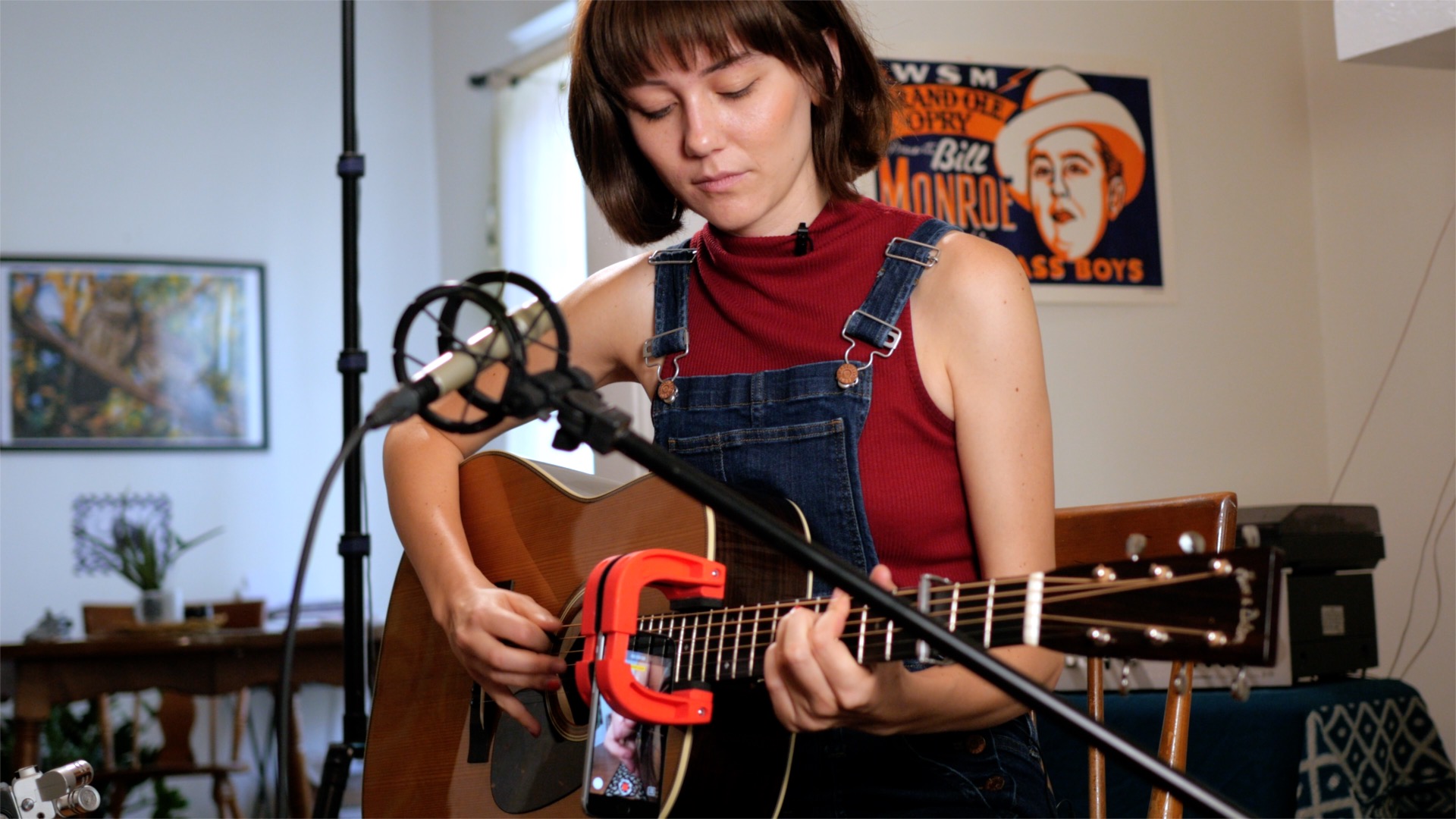
Molly Tuttle’s prodigious songwriting chops, ethereal voice, and physical command of the guitar join forces in service of a sound that is equal parts traditional and transcendent.

Molly’s bluegrass bona fides will be instantly recognizable to aficionados. Her musicality is deeply rooted in the genre’s standards and culture, and her command of notoriously challenging flatpicking mechanics easily ranks her among the guitar’s elite technicians. None of this is especially surprising considering she is the International Bluegrass Music Association’s Guitar Player of the Year for 2017.

What is unexpected is how this traditional mix of ingredients results in a sound that is just as at home on Spotify as it is in Walnut Valley. With over a million plays, Molly’s tune Lightning in a Jar is a breakout success on the platform’s “Indie Bluegrass” playlist, and as of this writing Molly herself is the playlist poster image. If the time is right for a mainstream take on bluegrass musicianship, Molly would seem perfectly poised to provide it.

In this hands-on interview, we get to the bottom of Molly’s astonishing right hand facility, including her approach to flat pick rudiments and roll patterns, gymnastic bass/chord rhythm techniques, and her very cool banjo-inspired clawhammer fingerstyle technique. We talk about fretboard visualization, songwriting techniques, and the additional polishing of all of these during her time at the Berklee College of Music.

The interview includes 42 tablature examples filmed in high frame rate, slow-motion video, with complete transcriptions of Girl in My Shoes, Save This Heart, and Molly’s blazing cover of the Townes Van Zandt classic White Freightliner Blues.

Martin Miller Through the Changes

By

It’s one thing to understand music theory, and another to apply it to the complex arrangement of overlapping strings and repeated notes on the guitar.

In this second interview with Martin, we deconstruct his process for improvising over flowing chord changes, arriving at a simple checklist that anyone can follow to start developing a mature improvisational vocabulary.

For experienced jazz and fusion players, this is an interesting glimpse into the workflow of an ace soloist. And if you’ve ever considered getting under the hood with jazz harmony and improvisation, this a great primer on how that kind of work is done.

Terry Syrek

By

Our interview with Terry Syrek is a revealing conversation about an elite player learning to live with a condition that severely affects his playing.

Terry is not only an incredible shredder, but a vocalist, producer, writer, and instructor. He’s been recording and releasing music for decades, and has performed alongside such legends as Steve Vai, Marty Friedman, Paul Gilbert, John Petrucci, and Zakk Wylde. He studied at Berklee, and has over 20 years of teaching experience.

He also has focal dystonia, a neurological movement disorder that affects the motor control of his fingers and limits what he can play. It’s not well understood, and there’s no magic bullet treatment. Terry visited a number of experts to try to figure out what was going on, and his diagnosis was just the start of learning to live with a new reality.

While it’s altered his relationship to playing the guitar, this condition hasn’t entirely quelled Terry’s virtuoisic chops, and it certainly hasn’t dampened his musical creativity! In this interview, we learn how Terry found ways to continue to write innovative prog guitar excursions despite his dystonia.

The conversation ranges from Terry’s time studying at Berklee, and the rigors of professionally competitive practice schedules at a top-tier music school, to his journey of self-discovery and healing after being diagnosed with this condition.

Teemu Mäntysaari

By

Teemu Mäntysaari is one half of the blazing guitar assault in the band Wintersun. With founder and vocalist Jari Mäenpää, he weaves punishing rhythms and intricate dual-lead flights of fantasy into epic power metal soundscapes.

When he’s not melting faces on the stage and filling hard disks in the studio, Teemu molds minds as a teacher in Helsinki and on the road. Of particular interest to Cracking the Code fans, this has included extensive work teaching pickslanting mechanics to guitarists of all levels.

In our talk, Teemu graciously shares his personal strategies for teaching pick grip and pickslanting interaction, converting students from one pickslant to another, using two-way pickslanting for arpeggio sweeping, maintaining tight hand synchronization through sweeps, and lots more.

Teemu’s dual perspective as both a player and a teacher is rare for a number of reasons. He has achieved, and continues to develop, an impressive level of personal mastery of the techniques. He has applied that mastery as a working professional in an internationally successful band. And he has somehow also found the time to develop insightful educational approaches for a technical discipline that didn’t even really exist a few years ago. Teemu’s work is an exciting model for how mechanical learning can happen in a new era driven by observation, testing, and student feedback, and we are thrilled that he was able to sit down with us.

Cracking the Code Help Center

By

Cracking the Code is a growing and vibrant community of musicians like yourself. It’s also a ton of stuff to watch and study: comprehensive lessons, a wide array of interviews, interactive tablature and video players, a forum, and more.

We put together this quick introduction to our platform to acquaint you with where everything lives, and how it works. You’ll learn where to find our lessons and interviews, how to operate the most important features of our video and tablature players, how to navigate the forum, how to get to your account settings, and more.