

Pour yourself a caipirinha and grab your thumb pick because the awesome César Garabini is taking us on a trip to Rio for an introduction to the beautiful and grooving sounds of Choro guitar.
Choro is a jazz style that originated in the latter half of the nineteenth century in Rio de Janeiro. Its rolling arpeggiated melodies and complex contrapuntal interplay recall American jazz of the period like Ragtime and Dixieland, but its emphasis on African rhythm and strings-heavy instrumentation is uniquely Brazilian.
Typically arranged for small acoustic bands lacking a bass player, choro’s driving rhythmic force is instead a seven-string nylon guitar. Played with thumb pick and fingernails, its trademark grooving bass rhythms blur the distinction between accompaniment and lead, frequently reaching up beyond the baritone register in intricate harmonized duels with the bandolim, or Brazilian mandolin.
In our interview with César we take a closeup look at how choro picking works, including César’s virtuoso thumb technique and its sophisticated handoff to picado for leads on the upper strings. We talk about how the additional bass string, tuned to C, dramatically expands the chord voice and comping possibilities of the instrument. Finally, we dive into improvisation and the kind of homework César does to build a rich vocabulary of ideas even in less guitar-friendly keys.
The one-hour interview includes 74 musical examples with tablature, with complete transcriptions to César’s duets with flat pick jazz virtuoso Olli Soikkeli on the choro standards “Um A Zero” and “Alumiando”, as well as Cesar’s solo performances of the Antônio Carlos Jobim classic “A Felicidade” and the American jazz standard “After You’ve Gone”.
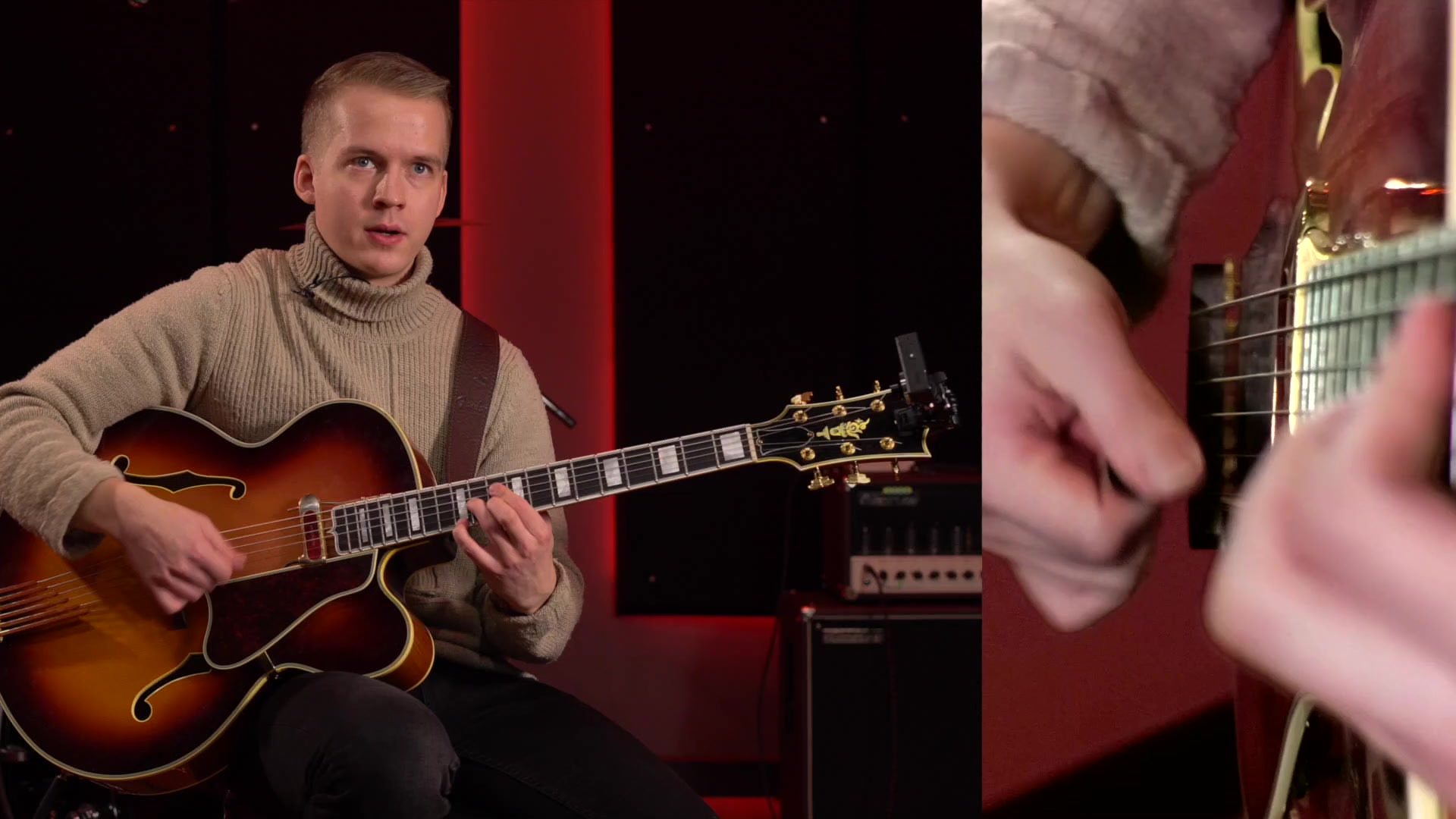
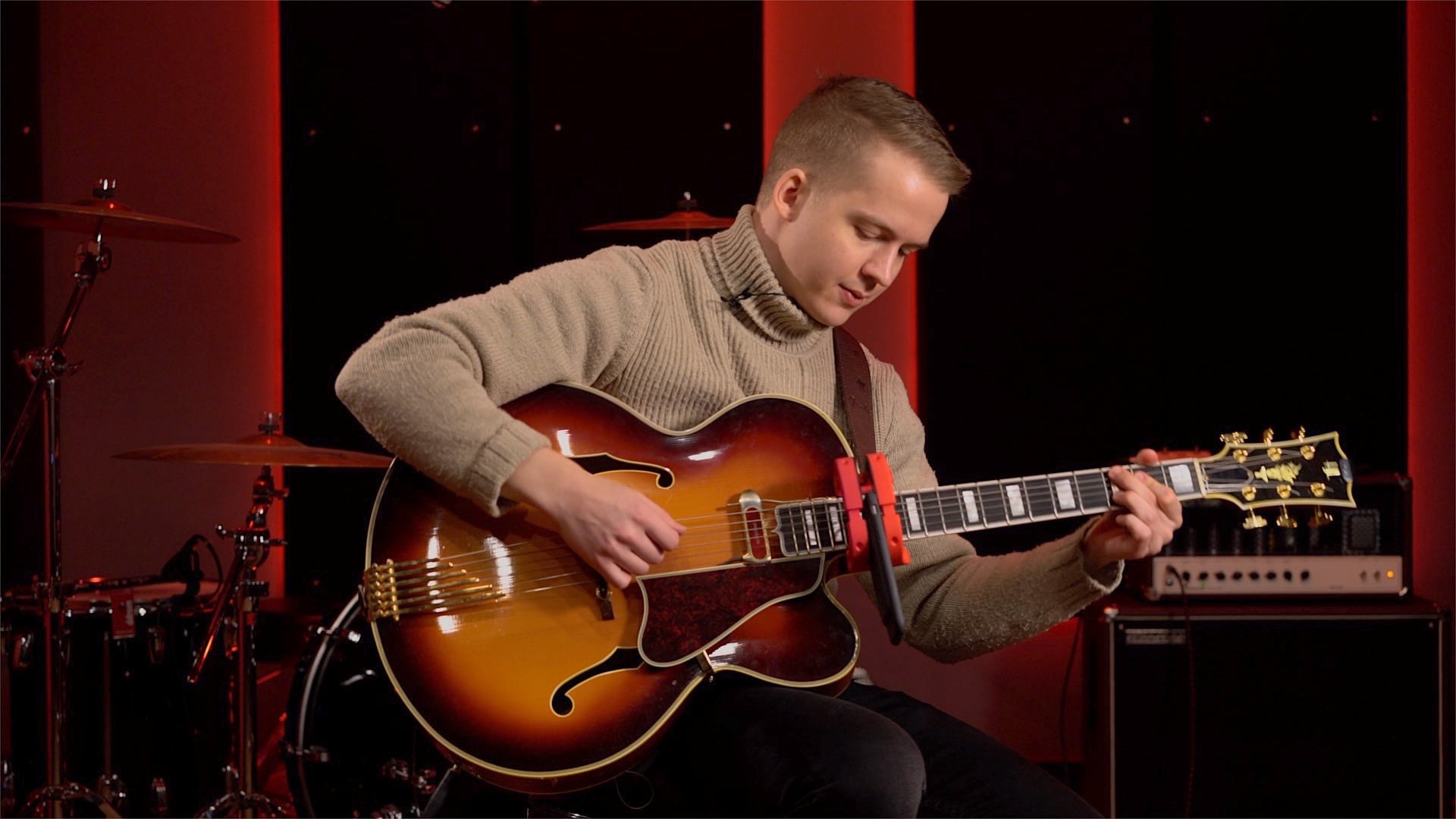
Olli Soikkeli’s tasty vintage stylings wouldn’t be out of place at a jazz age lawn party with linen suits and coupe glass cocktails. But when he fires up his 21st-century alternate picking technique, you’re about to take a ride in a DeLorean time machine of jazz guitar.
Olli’s blazing duets with Gypsy jazz stars like Joscho Stephan would already place him among the premier practitioners of that classic swing style. But when you take a close up look at his technique, you realize just how unusual that company is. Olli gets the sound, but he does it with alternate picking. This approach is less like Django’s storied rest stroke technique, and more similar to what you find at the elite levels of bluegrass guitar and classical mandolin.
It is perhaps this outsider perspective, both artistically and technically, that contributes to his unique sound. He has adapted and arranged dauntingly complex Brazilian Choro pieces by masters like Pixinguinha and filled them with a mix of influences from Django to the present. By deftly blending elements of European, American, and Brazilian jazz, he has created a voice that is as hard to pigeonhole culturally as it is historically.
In our interview, we get to the bottom of Olli’s awesome double escape alternate picking technique. Its semicircular curvature, clearly visible in slow motion, is what enables the arpeggiated leaps in challenging pieces like “Alumiando”, the duet with Choro master César Garabini that opens the interview. We discuss how Olli employs that technique while visualizing fretboard shapes for playing through changes. And we investigate his Gypsy-style strumming and tremolo techniques, which have also been adapted to his signature blend of old-time and modern sounds.
The full interview contains 102 musical examples, including complete transcriptions of “Alumiando”, arranged for both flat pick and seven-string Choro fingerstyle guitar, and Olli’s adaptation of Antonio Carlos Jobim’s haunting “Luiza”.

With an immediately recognizable voice that resounds through his signature arrangements of traditional tunes and original compositions alike, you always know when you’re listening to David.
And this is true even as that voice changes with different arrangements of the same song. In our latest meeting, we play four versions of the Monroe standard “Wheel Hoss” at various tempos, from a leisurely 180bpm eighth notes all the way to a blazing 300bpm. As the velocity increases, David’s arrangements become subtly more streamlined.
For his medium speed arrangements, he employs a double escape picking motion that enables intricate crosspicked sequences. At higher speeds, his technique expands to include single-escape motions, letting him hit the gas pedal on more linear lines. His trademark four- and five-string contrapuntal leaps are still present, but connected by a blazing fast lane of scalar playing.
In the complete talk, we also touch on topics in songwriting, practice, improvisation, and cap it off by playing through a pair of stunning new compositions from his latest album.
The one-hour interview includes 31 examples with tablature.