
If you have watched any Cracking the Code, you have no doubt heard about pickslanting. But “slanting the pick” only works when the picking motion matches the pickslant. It is absolutely possible to do one and not the other, and this is where things go wrong.
Pickslanting vs Escape Motion: What’s the Difference?
Pickslanting is really a two-part system: diagonal pick + diagonal escape motion. They are not the same thing, and they have to agree. When they don’t, you can get the dreaded garage spikes problem where the pick snags on the strings and can’t get through. Here’s a downstroke version:
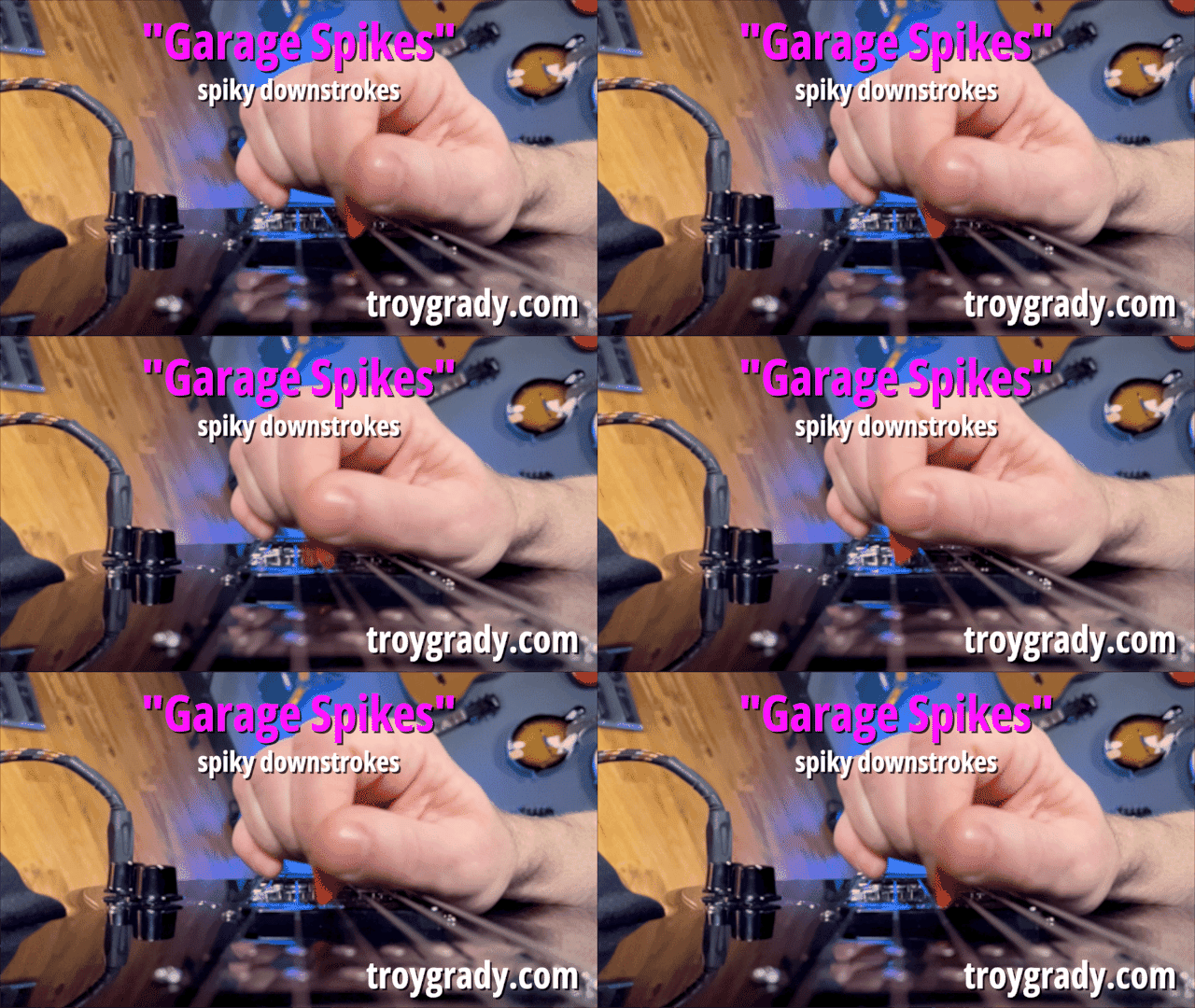
Notice how the upstroke is smooth, but on the downstroke, it snags badly. This causes a noticeable delay before the sound is produced, as the pick shuts down the string vibration by leaning against it. It also feels unsmooth, like there is too much string resistance.
Using The “Smallest” Amount Of Pick
You might be tempted to solve this by trying to “use less pick” to hit the string. But this would be a mistake. As the Magnet footage shows, garage spikes is not really a pick depth problem. The problem is that half the motion digs more than the other half. So the goal is to balance both sides. Andy Wood’s DSX technique shows how this works:
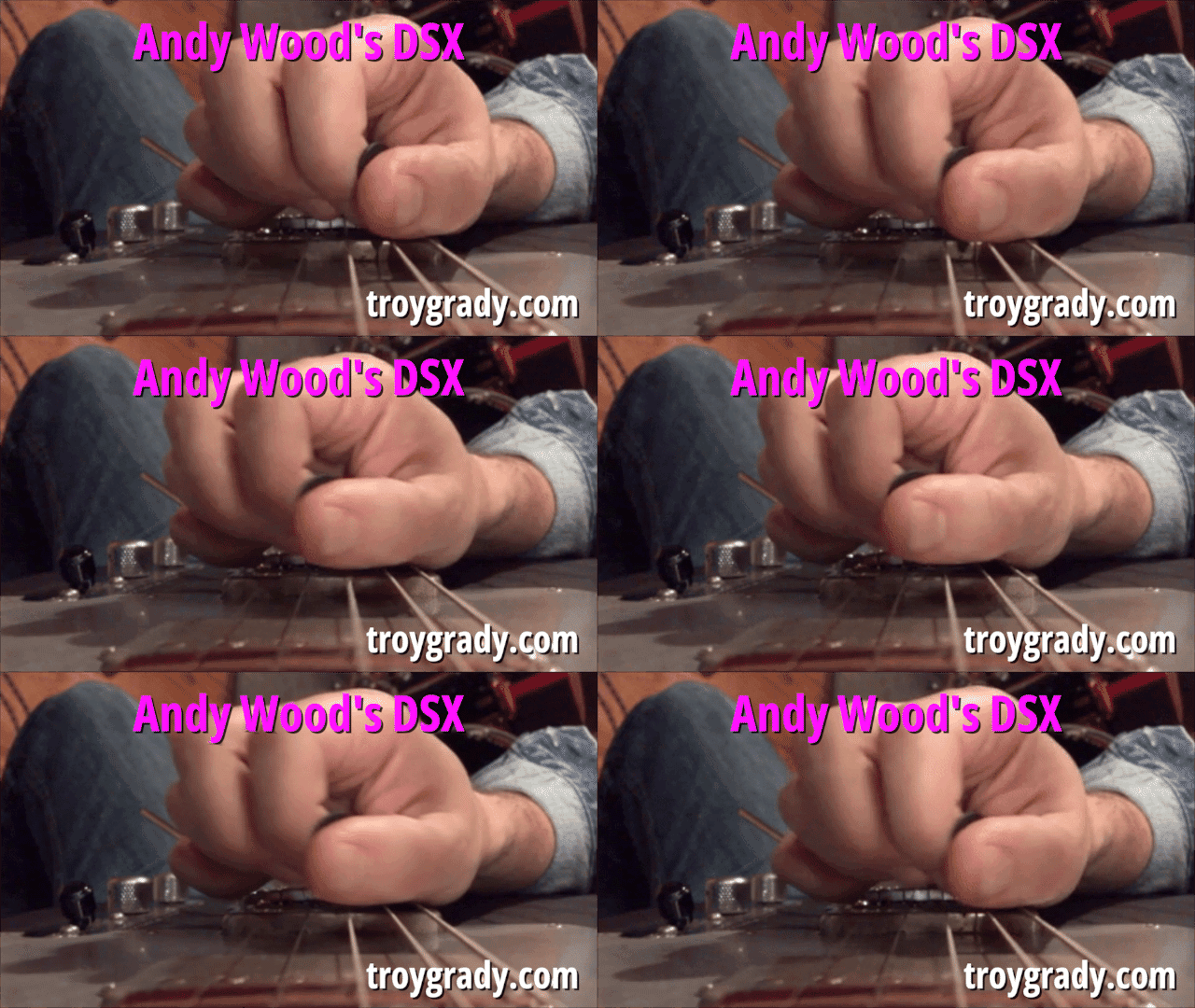
In Andy’s reverse dart wrist motion, the string moves equally in both directions, so the attack, feel, and sound is balanced. He does not need to use the smallest possible pick on the string to achieve this. This makes the string an easier and more reliable target. He’s not threading a needle here.
In other words, smooth pick attack is just what happens when the pick’s orientation lines up with the way it’s moving. So it’s not a posture problem, a pick grip problem or a picking motion problem: it’s all of those things. They all have to work together as a system.
Stopping The Spikes
Known “good” picking techniques like Andy’s already solve the garage spikes problem. They were probably discovered most often through trial and error by generations of self-taught players, shredding away in their bedrooms – or in Andy’s case, at elite bluegrass flatpicking competitions! When you land on one of these combinations, the technique “just works” and you don’t have to think about pick attack.
The “small amount of pick” myth has persisted for years. Like a lot of common wisdom, it endures because there is a kernel of truth there: in theory, if you use “too much pick”, you won’t be able to get through the string. The problem is that this is just not what happens most of the time. Garage spikes is much more common, and the fix is to use a known working combination of overall form, pick grip, and picking motion.
Get Critiqued
In Technique Critique, we see and fix garage spikes issues daily. Along with stringhopping, speed issues, hand sync, and a lot more. If you want us to take a look at your playing, it’s still included in the membership as a standard feature, and we’re happy to do it! Sign up right here in the Cracking The Code Store:


Quick and easy one-pager on garage spikes with some cool illustrative GIF animation loops to really make this obvious. We also make these for players who hit us up in Technique Critique, and it can really drive the point home in a simple way when you see this in your own playing.
More generally, before I started doing this for a living, I never would have guessed how common certain basic problems are. Stringhopping, for one. It was something I encountered only when trying to switch strings against my (most likely) self-taught USX technique, which I was unaware of at the time. But on a single string I don’t think it really happened. It never occurred to me that some players might learn this even on a single string, on every note, as their actual full-time primary picking motion. And two, garage spikes. Super common – maybe the most common picking problem alongside stringhopping.
What’s particularly problematic about both of these is that they are radical early gates. If they happen, you either can’t play very fast, or you can’t play at all. It’s clear there are probably lots of players who hit these roadblocks early and made significant choices in response: maybe switched to legato / sweeping, maybe switched to keyboards, etc.
Of course! The Primer is very consistent on this. This was a fun thing for YouTube where we wanted to mirror the old Joe clip.
This was also not intended to be a tutorial on how to actually do a USX picking motion. I was clear on that - otherwise this would have been a much longer video. The main takeaway from this lesson is that it really doesn’t matter which USX technique you use, only that upstrokes escape. So for this lesson, the jacket fits! (Ha.)
Finally, I understand that the tremolo demonstration looks like forearm - it is! But that’s somewhat idiosyncratic to me. It’s the only part of the lesson that really uses this motion, and not something I intended anyone to specifically mimic. The two-handed playing is mostly wrist with relatively little forearm, especially on middle and lower strings. This is similar to what Joscho Stephan does. Here is what it looks like - if you watch the forearm you will note how little it actually rotates most of the time:
https://www.instagram.com/p/CH4C2qhHxda/
I think two-way economy types can probably still have a garage spikes problem if they don’t do much actual alternate. Note that garage spikes is specific to alternate, since it only happens on one of the pickstrokes - either the downstroke or the upstroke, but not both. It’s the “one way” nature of the problem that makes it like the parking garage spikes.
If you’re saying more generally that sweeping forces you to figure out smooth attack when sweeping in whichever direction, yes, for sure. But I can easily imagine a person who can do a five-string sweep in both directions, but when they try rapid alternate picking on a string, they get the spikes issue. It’s sort of it’s own animal.
To put this another way, we have definitely worked with players who had a decent two-way economy type vocabulary, but couldn’t tremolo, because the style doesn’t expressly require it. I’ve come to understand that there is a subcategory of players who moved toward economy because alternate is not obvious to figure out. In other words, I think economy is chosen very often not so much because it’s “economical”, but because it might be the only way a player can figure out how to get certain lines at all.
Let me know if I’m understanding you correctly!
I would hesitate to attribute anything to purely practice at this point. For example, on your “delay between upstroke and downstroke” comment:
Garage spikes can definitely cause that, and you can SEE it. The downstroke pauses as it snags on the string, shutting off the sound too. This is not a thing that “practice” fixes, per se. The only way this gets fixed is if you change the technique. If you do a thousand reps and your technique is different, that’s not really repetition – that’s change.
The problem is, good players may reflect on their progress, and think, well, I had this problem, then I did a thousand repetitions, and now I don’t, therefore I was sloppy / inaccurate / etc. Insert whatever reason you like. Just because I think I know what caused a thing doesn’t mean I really do. Video is one way to cut through the noise.
So, this is going a little far afield, but I DID take a few moments to film some video today. I don’t have a great eye for this stuff, still, but:
Full speed:
https://www.youtube.com/watch?v=3u2YEHEkyUoSlo-mo after a second or two:
https://www.youtube.com/watch?v=DkytlZkSTFsComments: