Here’s the bad news: The individual lesson chapters in our awesome Synchronicity seminar don’t work very well as YouTube videos. They’re concise, nutritional, and exactly what you want in a lesson sequence. They are not what you want for competing with pranks and ASMR.
And now the good news: Synchronicity author Tommo made an entirely new lesson for public consumption – which is packed with just as much instructional value and even more entertainment. It expands on the “Constant Picking Speed” concept from the seminar, and you can watch it right here:
On The Beach
The jumping off point of the lesson is a guitar-famous lick you may recall from Paul Gilbert’s “Intense Rock II” instructional video. It’s “The Beach Lick”:
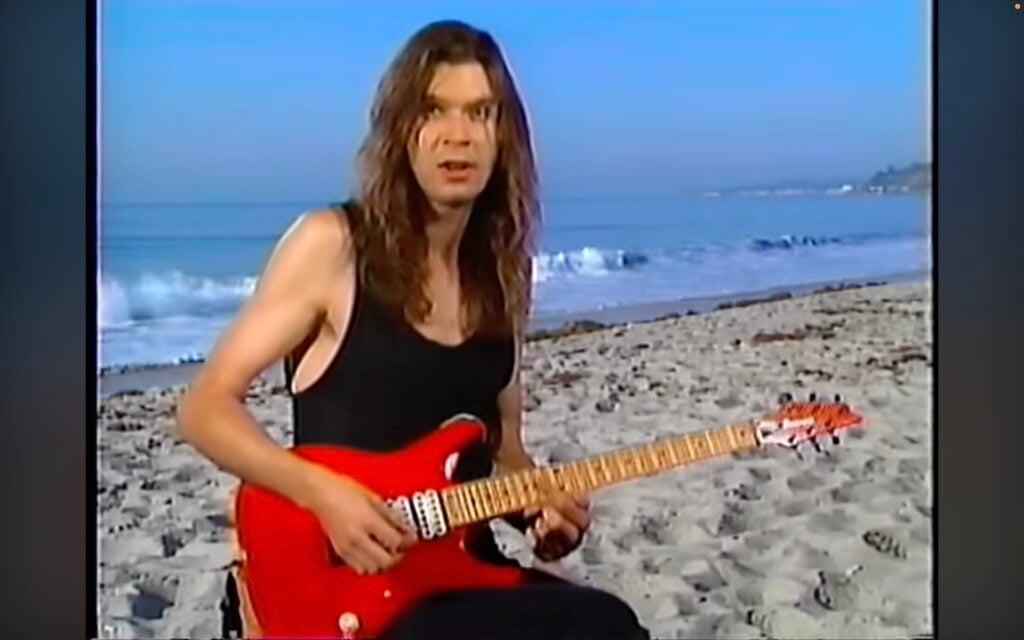
The phrase is typical Paul. It’s aggressively patterned and delivered with his tradmark perfectly synchronized alternate picked attack. It’s also nearly impossible to notate – at least if you want it to look like what it sounds like. Is it a feeling of three? Four? Six? What’s the time signature? It’s anyone’s guess.
Getting Metronomic
Intense Rock I’s famously triplet-focused scalar studies may be responsible for more metronome sales than any other educational product of the 1980s. Indeed, we named a whole seminar as an homage to it. But The Beach Lick’s seemingly random construction defies metronomification. How do you practice something you can’t count?
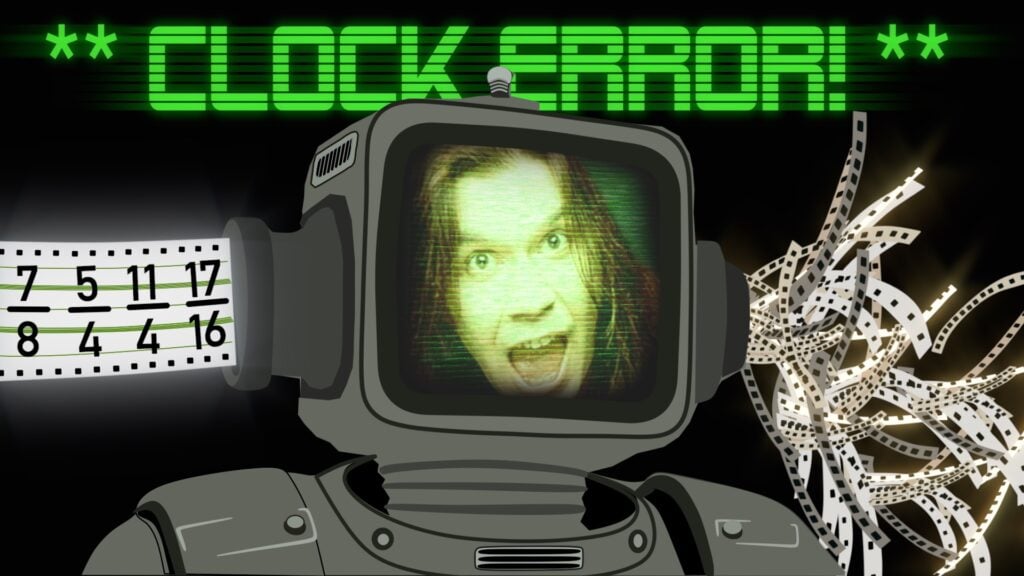
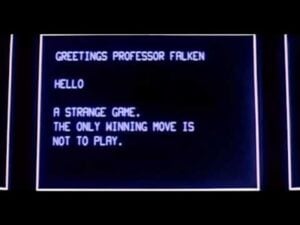
In the YouTube lesson, Tommo investigates the ways you could configure a metronome or sequencer to keep up with The Beach Lick’s randomly weird patterning: Tempo maps? Metric modulation? One click per note?! These all work in theory. But they’re either hard to follow, laborious to prepare, unsupported in software, and more importantly just missing the point. As they say in the movie Wargames, sometimes the real winning move is NOT to play:
Continuous Picking Speed
You may recall from Synchronicity that Constant Picking Speed, or “CPS,” is our term for a simplified approach to chaining together phrases. The concept is this: to join patterns of different lenghts, don’t kill yourself calculating complex time signatures or metric subdivisions. Instead, just focus on the mechanical landmarks in a rhythmically free-time way.
This sounds hand-wavy, but it’s not. The thing you’re really trying to learn is hand synchronization, and it depends on neuromuscular cues which are non-metronomic. This is why great players like Yngwie Malmsteen can stay locked in the absence of an external click, and even while speeding up or slowing down.
So the click was always secondary. And switching it off is not just a way to make practice simpler. It also makes practice more effective because it forces you to explicitly employ chunking, which is the real solution to the problem. More on this in the lesson.
Even More Synchronicity
We’re still working on the third and final batch of Synchronicity chapters, which should be out shortly. In the mean time, check out Tommo’s lesson for the latest on convoluted click track configuration and Finnish wife-carrying competitions. It’s got everything you need!
Start the discussion at The Cracking the Code Forum