
Nonuplet Meta Chunking
Nines
- Visibility
- Public
Uploaded
View video
Videos shared by Troy.
Nines

How to "swipe out" the slow!

A very common problem we see in Cracking the Code is when players use USX form but still make a trapped motion. Try this slight adjustment and see if it helps.

The simplest “fast” scale fretting you can do.

If “one finger per fret” feels awkward or slow try this instead.

What’s the difference?

Two methods

Quick instructions for doing the Al Di Meola / Andy Wood reverse dart wrist motion test on the desktop. When you do this, try to get a motion size at least as big as what I'm doing. Super tiny motions can have trouble getting far enough past the string to avoid buzzing or cutting off the sound.

Thumb technique has built in accents which make it easy to get bop-style dynamics. Also, a common issue we see in TC is players using USX form but trying to play non-USX patterns swith it. Thumb technique is a good way to test this, since it can really only do USX motion. If the thumb can play it, then it’s probably a valid USX line that you can also do with a pick.

Smooth versus unsmooth pick attack.

Replicate for max comfort

On a table, you only hear the "down-taps" since the "up-taps" don't make any sound. But on a string, the ups would also play a note thanks to alternate picking. So when tapping on a desk, accenting groups of twos feels pretty similar to chunking sixteenth patterns in groups of four. And accenting every third tap feels like alternate picking chunked sextuplets. This is how chunking works with picking: you only focus on the downstrokes, and especially the initial downstroke.
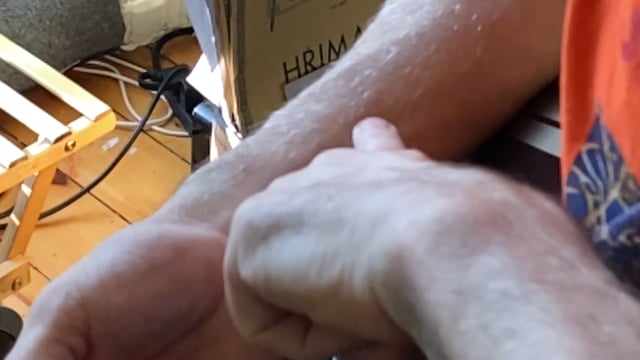
Comparison between flatter arm position and tall mouse arm position. In the flatter position, the motion is either small mouse or deviation. In the tall mouse position, the motion is more ergonomic and faster. If you use the tall mouse form and can't reach the strings with the pick, then you may need to change the pick grip in some way, either by bending the thumb or index finger, or by switching to trailing edge grip as in the Primer "Tall Mouse" lesson.
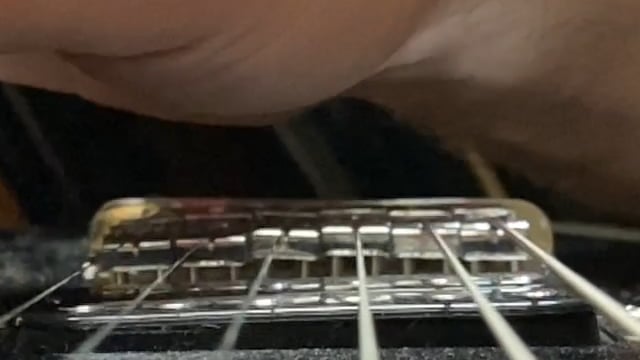
No wah pedal? No problem! Here's a fun pattern that uses Gypsy-style strumming technique to simulate the sound of a wah pedal. You start with a downstroke that strikes the top two or three strings, followed by an upstroke that only strikes the high E string – to get the wah "click". The third motion is a downstroke that taps your index finger nail on the lowest strings, approximately E or A, or some mix of the two. Then you repeat. This creates a DUD-DUD-DUD pattern, which is similar to patterns the Gypsies use when picking three-note-per-string scales. Because of the repeated downstroke it's not perfectly efficient, so there will be a speed limit. But you can still do it fast enough to get the wah effect. It's a bit of a tongue twister, and like many things in guitar picking, in order to learn this, you have to fool around with it at fast speeds first, to get a sense of what it feels like when it loops. Since this is a pattern of threes being played as sixteenth notes, it doesn't divide evenly into a bar. To loop it, I do the first beat a little differently — a chord stab for three sixteenths, followed by an uptroke. Then, to fill out the rest of the bar, just do four repetitions of the pattern. When the next downbeat arrives, you'll still have to do two downstrokes in a row to get the chord stab.