
USX and Downpicking
USX alternate picking and downstroke sweeping form a powerful core system, but many players add another ingredient: downpicking. Used strategically, an extra downstroke can solve phrases that the core USX economy motions cannot.
This combination appears in rock, metal, jazz, and acoustic picking styles, often in short bursts rather than long continuous streams of downstrokes.
George Benson
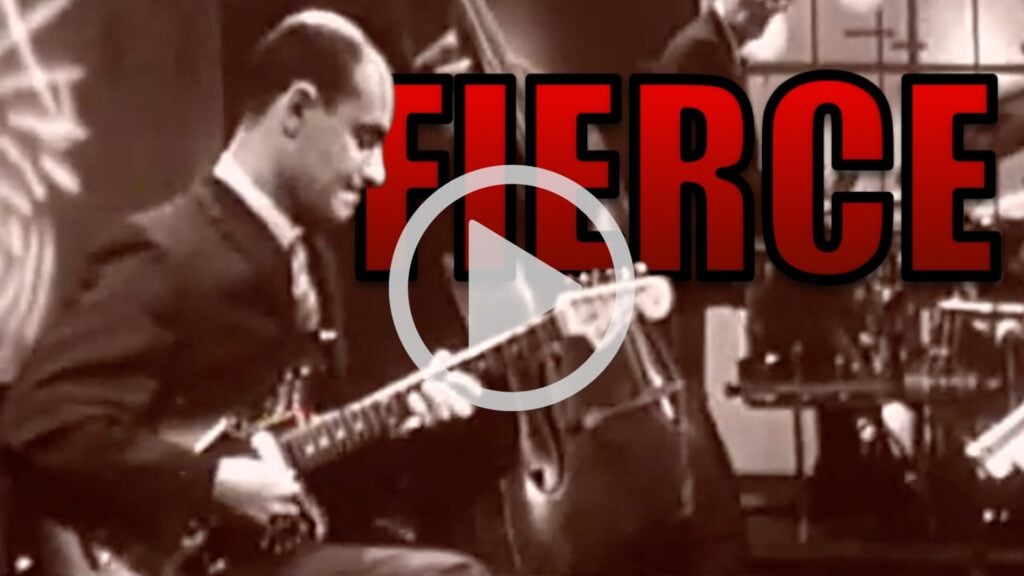
It also includes jazz legend George Benson, whose technique has been pored over by legions of jazz fans not just for his tasty playing but also for his mechanics. In this regard much discussion has focused on George’s use of trailing edge pick grip, in which the thumb is hyperextended in a “hitchhiker” orientation, and the pick strikes the string with a high degree of edge picking:

George’s grip, while easy to notice and less common than leading edge pick grips, is a bit of a red herring. His lines don’t depend on it for speed or accuracy, and can be played with any of the numerous grips and arm setups that USX economy players use.
Instead, what George’s bop-inspired vocabulary does depend on is its extensive use of USX economy staples like even numbered groupings and downstroke sweeping:

In this example from his Hot Licks instructional video “The Art of Jazz Guitar”, George begins with three chromatic pickup notes leading to a diminished seventh arpeggio built on stacked instances of DDU:

What George is demonstrating here is that the DDU sequence as a unit is portable across pairs of strings. George executes the first DDU on the A and D pair of strings, to play the first diminished triad. He then does the same thing on the G and B pair for the second triad. The switch between the two pairs is alternate picking, but because the DDU sequence ends on an upstroke, which is escaped in USX motion, the move is perfectly efficient even at high speed.
By contrast, when he’s strictly alternate picking, George’s penchant for even-numbered note groupings becomes clear:

When downstroke sweeping is removed from the picture, George’s principal remaining picking motion is USX alternate picking. In the first descending phrase in this example, George traverses a full five strings while playing nothing but two- and four-note groupings:

So for pure alternate picking, USX economy players are essentially single-escape players, specifically choosing phrases with even numbers of notes per string, to ensure that string changes always occur during upstrokes.
Downpicking
One counterintuitive component of George’s USX economy style is downpicking: using consecutive downstrokes, often to play single notes on strings by themselves. George makes liberal use of this in descending lines where downstroke sweeping is not possible, such as this minor 9 arpeggio:
While it is not immediately obvious at full speed, the slowed phrase contains four places where George briefly replaces USX alternate picking with downpicking, highlighted here in red:

Every downpicking cycle must return above the string without sounding an upstroke, but the exact path varies. George appears to use a visibly rounded path, while other efficient forms can look much closer to USX alternate picking, with the return path only narrowly missing the string:

This returning path allows a single note to be played without hitting the surrounding strings, or several notes on one string to be played entirely with downstrokes, as in metal rhythm playing. George uses both possibilities here, beginning with a one-note-per-string arpeggio and finishing with consecutive downstrokes on the low E string.
The price is note efficiency. At the same joint-motion speed, alternate picking sounds both phases of the motion while downpicking sounds only the downstroke, producing half as many notes. This creates a real speed ceiling for continuous downpicking. Short bursts of one or two downstrokes can be performed faster than long continuous sequences, but players still tend to favor pure alternate picking or sweeping for their fastest passages.
If downpicking sacrifices note efficiency, why use it at all? For USX players, it acts as a get-out-of-jail-free card when an upstroke escape, legato note, or downstroke sweep does not solve the phrase. A strategically placed extra downstroke can preserve the rest of the picking sequence without requiring the player to reorganize the larger motion.
Considering the increased range of fretboard patterns it allows players to execute with picking, and the broad tempo range over which it is mechanically possible, the efficiency penalty of the circular downstroke seems a reasonable compromise. The widespread use of this technique is a de facto confirmation of its usefulness, appearing in the techniques of USX economy players in a wide range of styles, like metal master Joe Stump:

In this repeating pattern, Joe actually uses the motion to connect a downstroke sweep with a successive downstroke on the same string:

In this application, Joe turns the tail end of the sweep into a downpicking cycle whose return phase avoids the string. This lets him restart the pattern on the E string with a downstroke, preserving the same picking sequence on every repetition.
Joe Pass
Young Joe Pass used a remarkably complete version of this style: fast USX alternate picking, downstroke sweeping, legato, and short bursts of downpicking. His mechanics were essentially identical to Gypsy picking for practical purposes, even though the music he played was not jazz manouche.
In the fastest form demonstrated in our lesson, downpicking can follow almost the same diagonal path as USX alternate picking, with the return path barely missing the string. This is one efficient solution rather than a universal shape; other players, including George Benson, can use a visibly rounder path.
Joe could insert one- or two-downstroke bursts at roughly 270 to 280 beats per minute in eighth notes—about 135 to 140 beats per minute in sixteenth notes. That is extremely fast downpicking, but the 50-percent note-efficiency penalty still imposes a real ceiling, so his fastest continuous lines rely primarily on alternate picking. Our full video lesson, Young Joe Pass Was Terrifyingly Good, examines the complete system.